
Admitted in writing, found no evidence
Two solicitors, one case file, two complaints to the regulator.
This complaint starts with a lawyer whose only real client was himself. Samuel Roberts told the court he acted for the plaintiff. He later told the OLSC he’d never dealt with the plaintiff, and that his instructions came from his own debt collection company. He had no contact with the other side either. Neither party lived in NSW: the plaintiff was in Victoria and the defendant in Queensland. He ran the case in NSW anyway, ex parte, so the court only ever heard from him.
The record is small: a thin Local Court file, and two letters he wrote to the OLSC. There are no competing versions of events to weigh. What matters is what the lawyer filed, what he admitted in writing, and what the OLSC did with it.
1. What he told the court
Samuel Roberts, the principal of Roberts Legal in Newcastle, registered a 12-year-old Victorian judgment in the Local Court of NSW. He signed the registration papers himself, as the solicitor on the record.
Registration only lets a creditor use NSW’s enforcement tools. The judgment can be enforced in NSW only if it could still be enforced in Victoria (Service and Execution of Process Act 1992 (Cth) s 105(5)). In Victoria, a judgment more than six years old can’t be enforced without the court’s leave (Supreme Court (General Civil Procedure) Rules 2015 (Vic) r 68.02). No leave was sought, and nothing on any file shows any money was owed. In NSW it was a dead end.
That afternoon the court’s system recorded something else: a “judgment of the Local Court of NSW”, made that day, for $111,379.40. No NSW court had decided anything (see enforcing an interstate judgment in NSW).
A garnishee order directs a bank or an employer to pay a person’s money to someone else. In NSW, applications are free and unlimited, and a registrar issues the order without a hearing.
Mr Roberts then misused that record. He’d registered a Victorian judgment for $120,898.15. At 5:11 pm the court emailed him a Notice of Orders Made recording a Local Court judgment for $111,379.40. Three minutes later he forwarded it to Fast Track’s staff: “Fyi, see attached including amount of interest.” As the solicitor on the record, he knew what he’d filed, or ought to have known. Over the next 18 months the registry issued 24 garnishee orders on his applications. Every order described the debt as a judgment of the Local Court of NSW dated 31 August 2016, and claimed $111,379.40 plus interest. They went to banks, employers and other institutions around Australia.
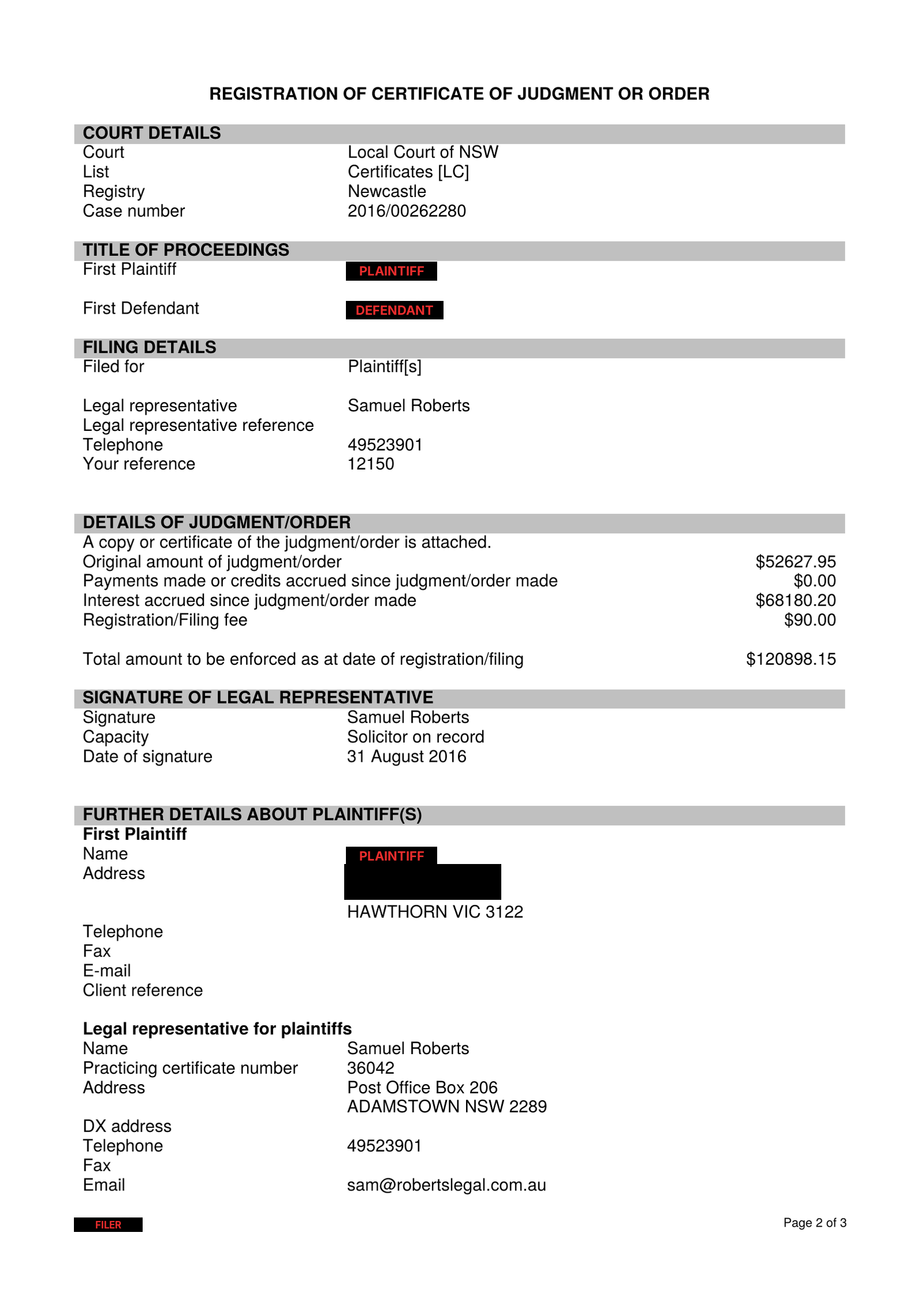
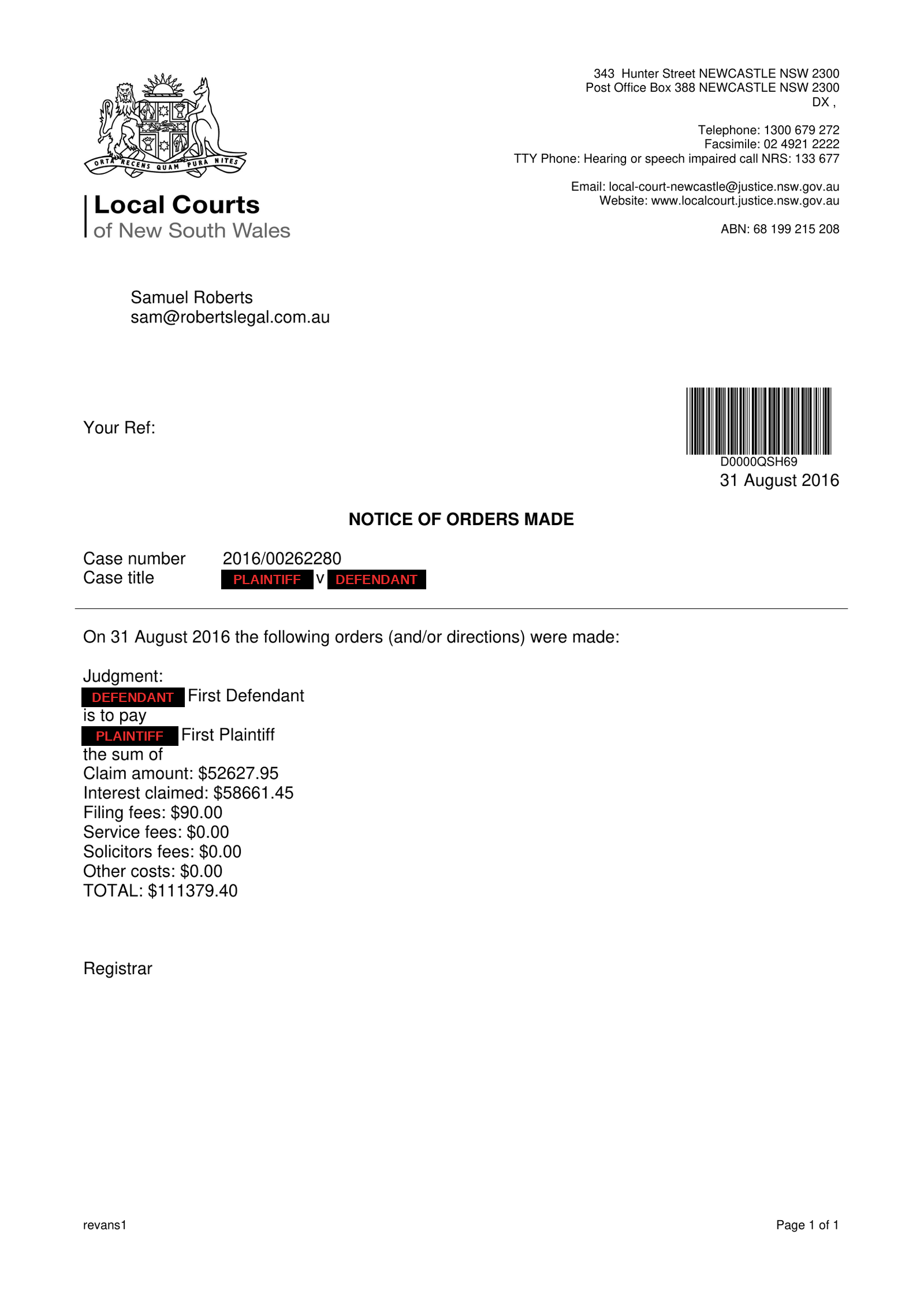
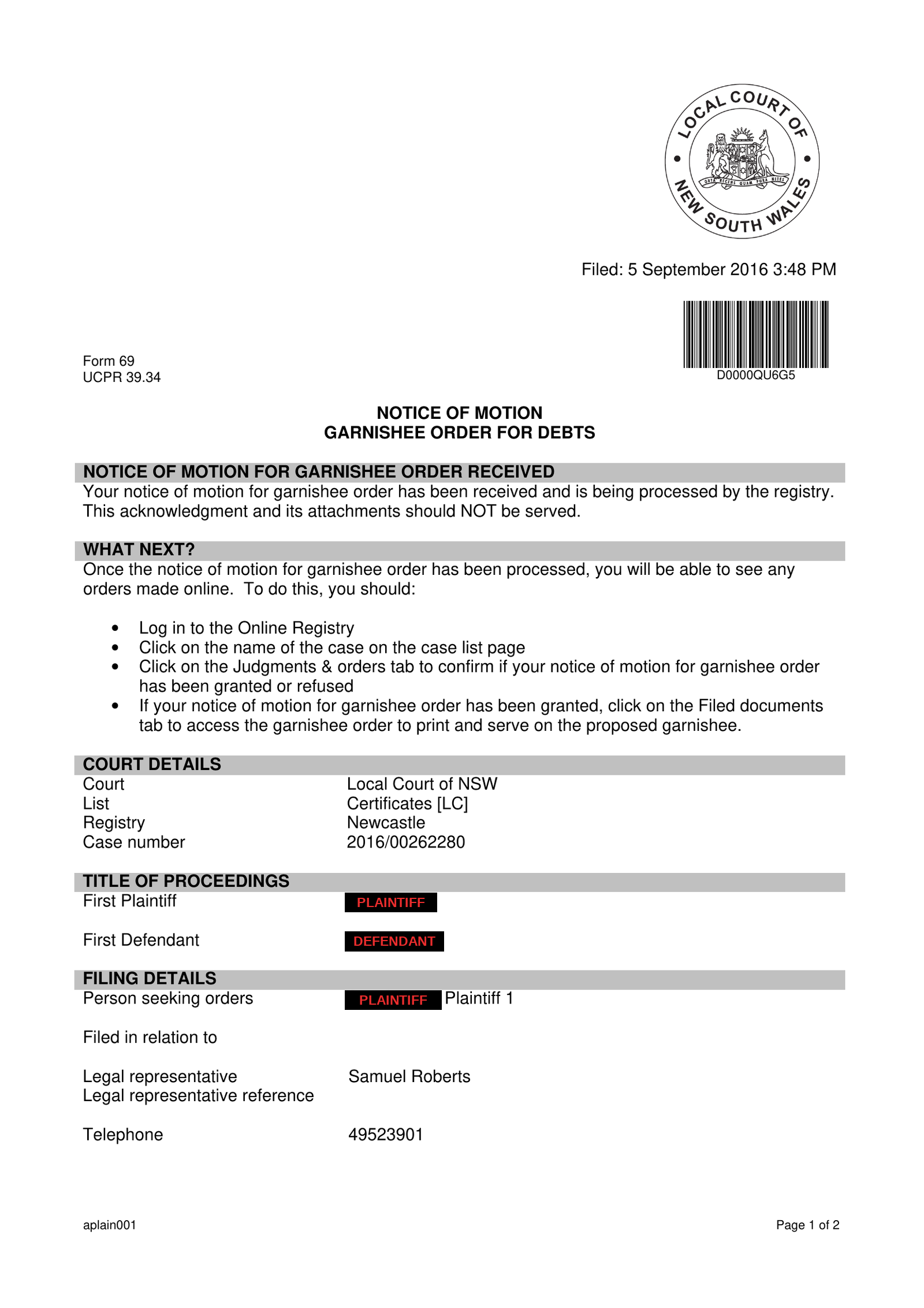
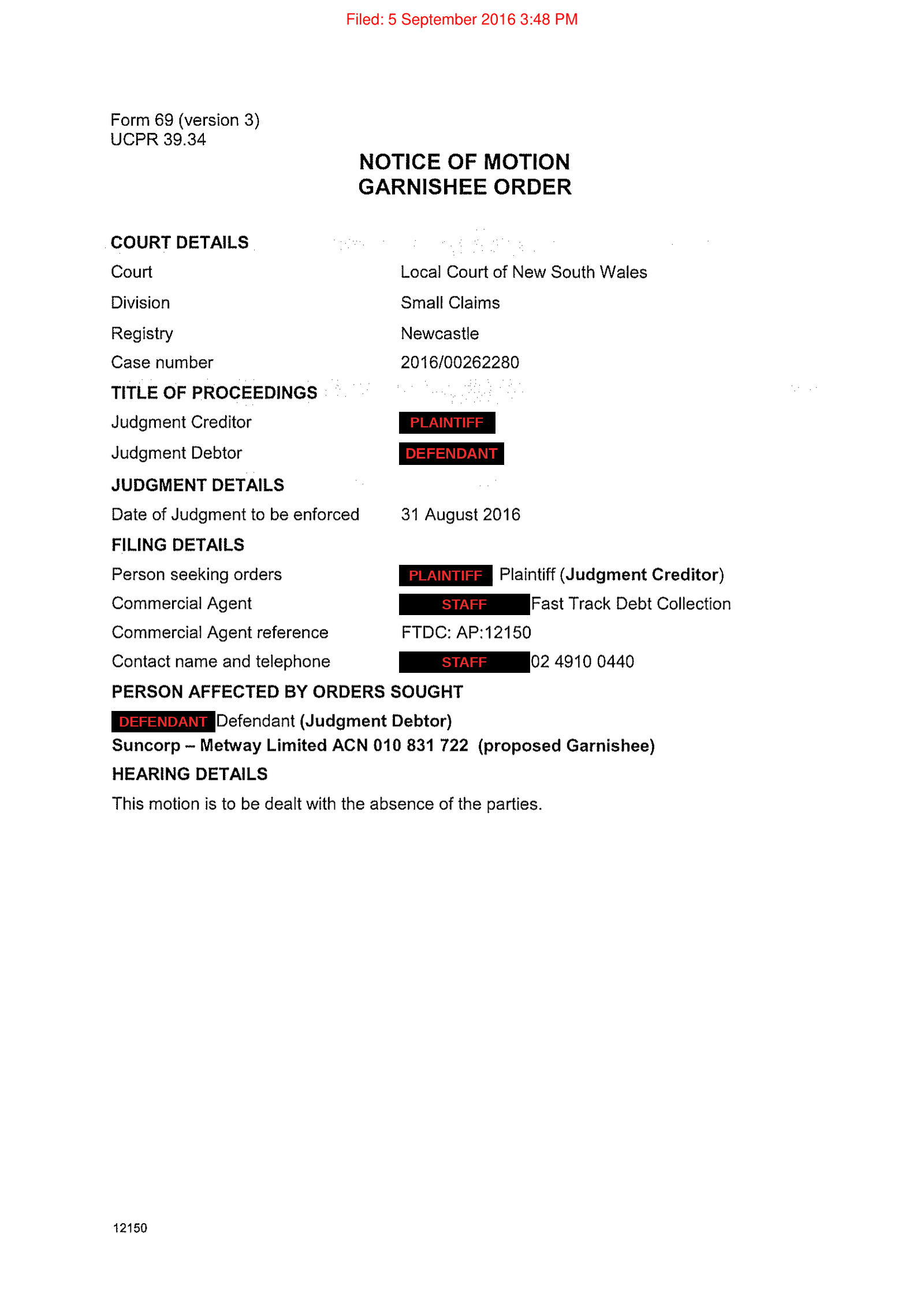
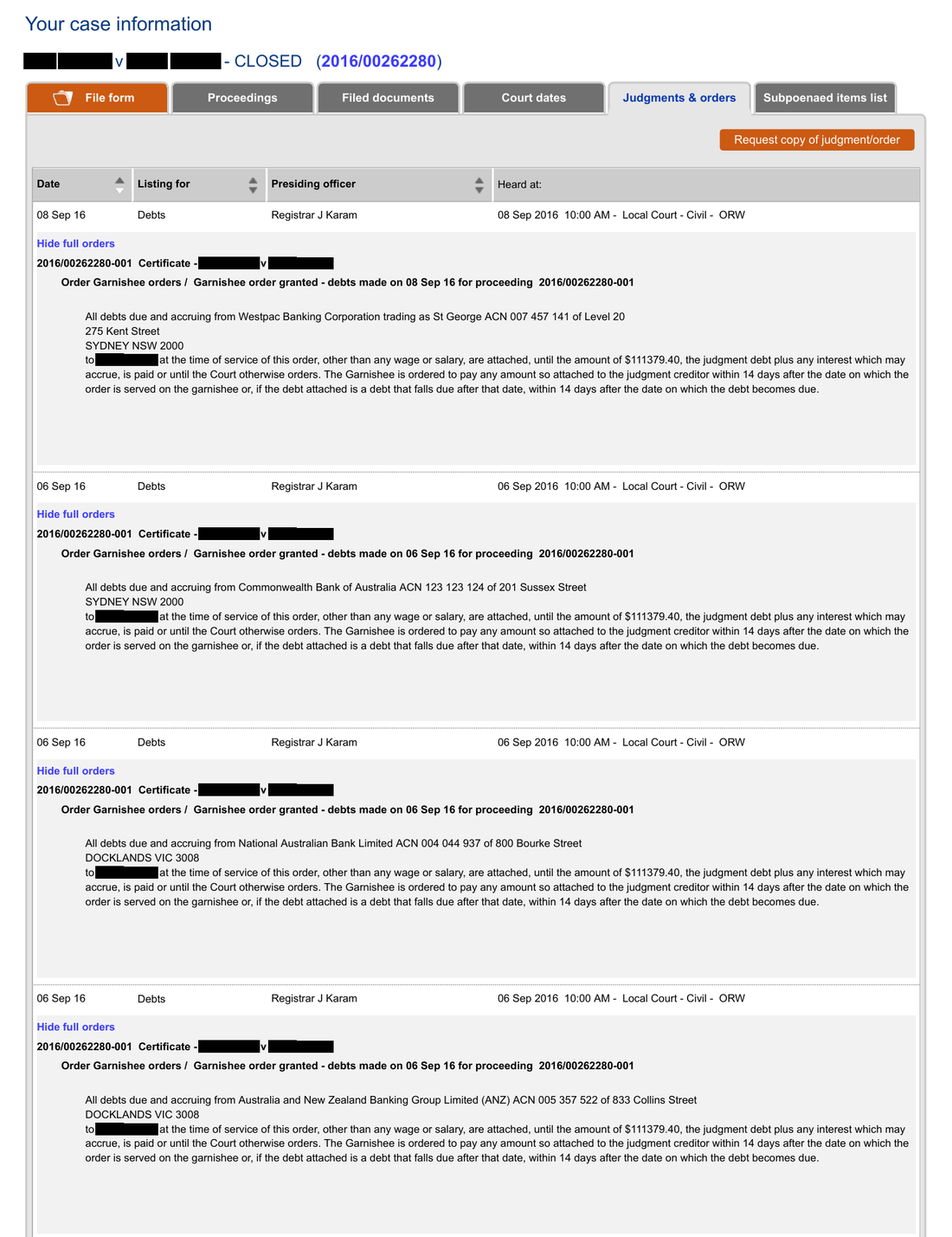
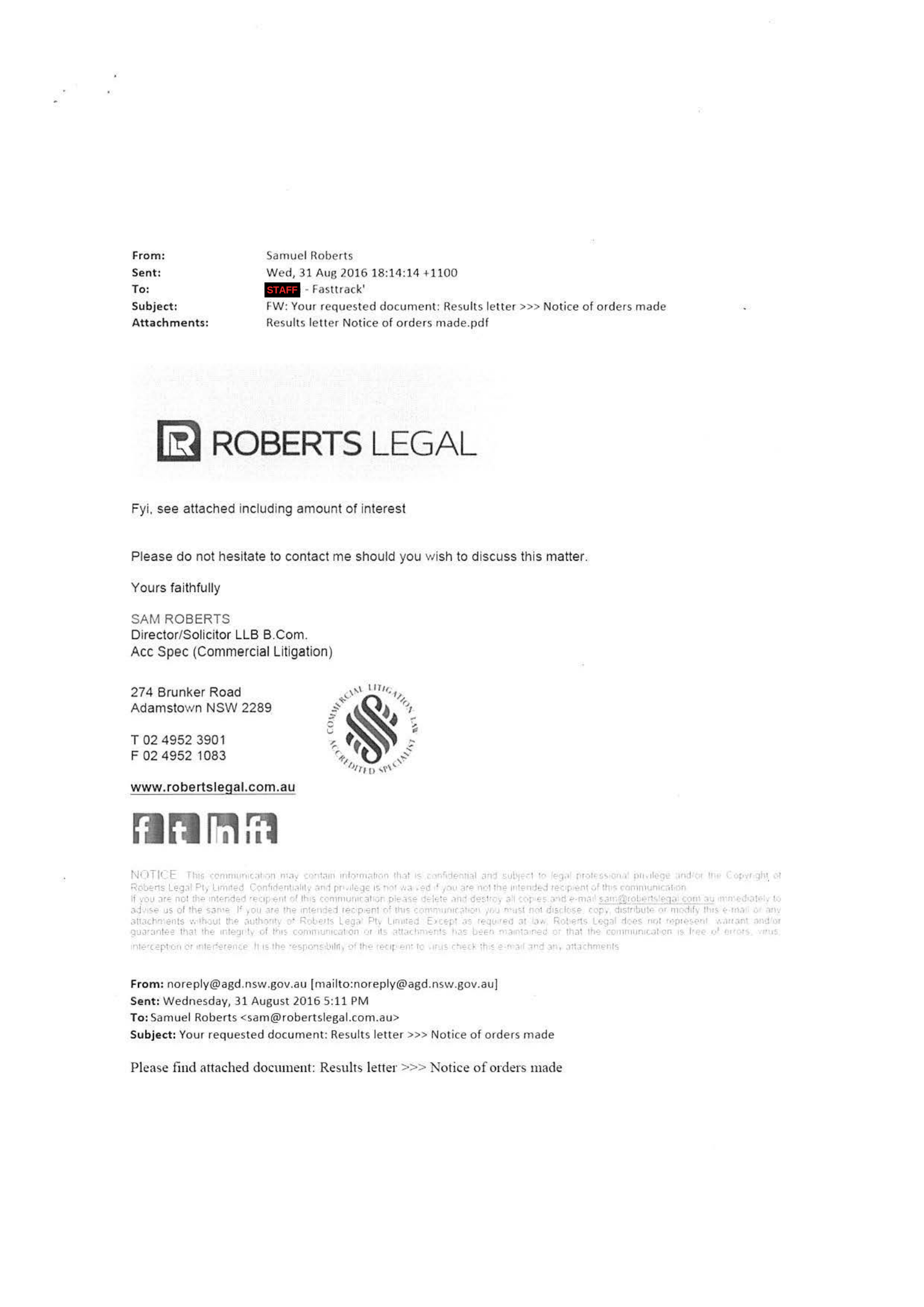
Registration and Notice of Orders Made, 31 August 2016. Mr Roberts’ email to staff, 5:14 pm. Garnishee application and order, 5 September 2016 (one of 24). NSW Online Registry, 14 April 2021.
2. What he advertised
Mr Roberts ran both sides of the business. Fast Track’s website called him its “founder and Managing Director”, and “also the Principal Solicitor of Roberts Legal”. It called Roberts Legal “Fast Track Debt Collection’s integrated law firm”, and Roberts Legal disclosed that it shared “common ownership” with Fast Track.
A creditor signed Fast Track’s Collection Service Agreement, which appointed Fast Track, not a law firm, as its collection agent. The terms let Fast Track instruct “its Solicitors, Roberts Legal” (cl 1.4), and authorised it to have Roberts Legal “sign Court related documents on behalf of the Client” (cl 9.2(b)). Fast Track was paid only if it collected, on a sliding commission: 12.5% on debts over $100,000 (cl 6.1 and the Commission Schedule).
The only check on the debt was the client’s word. The client “warrants” that each debt is “due, owing and payable” and that it knows of no dispute (cl 5.3). No questions asked.
A solicitor must act on the client’s own instructions, not a collection agent’s (Solicitors’ Conduct Rules r 8.1). And a law practice can’t be paid by reference to the amount recovered (Uniform Law s 183).
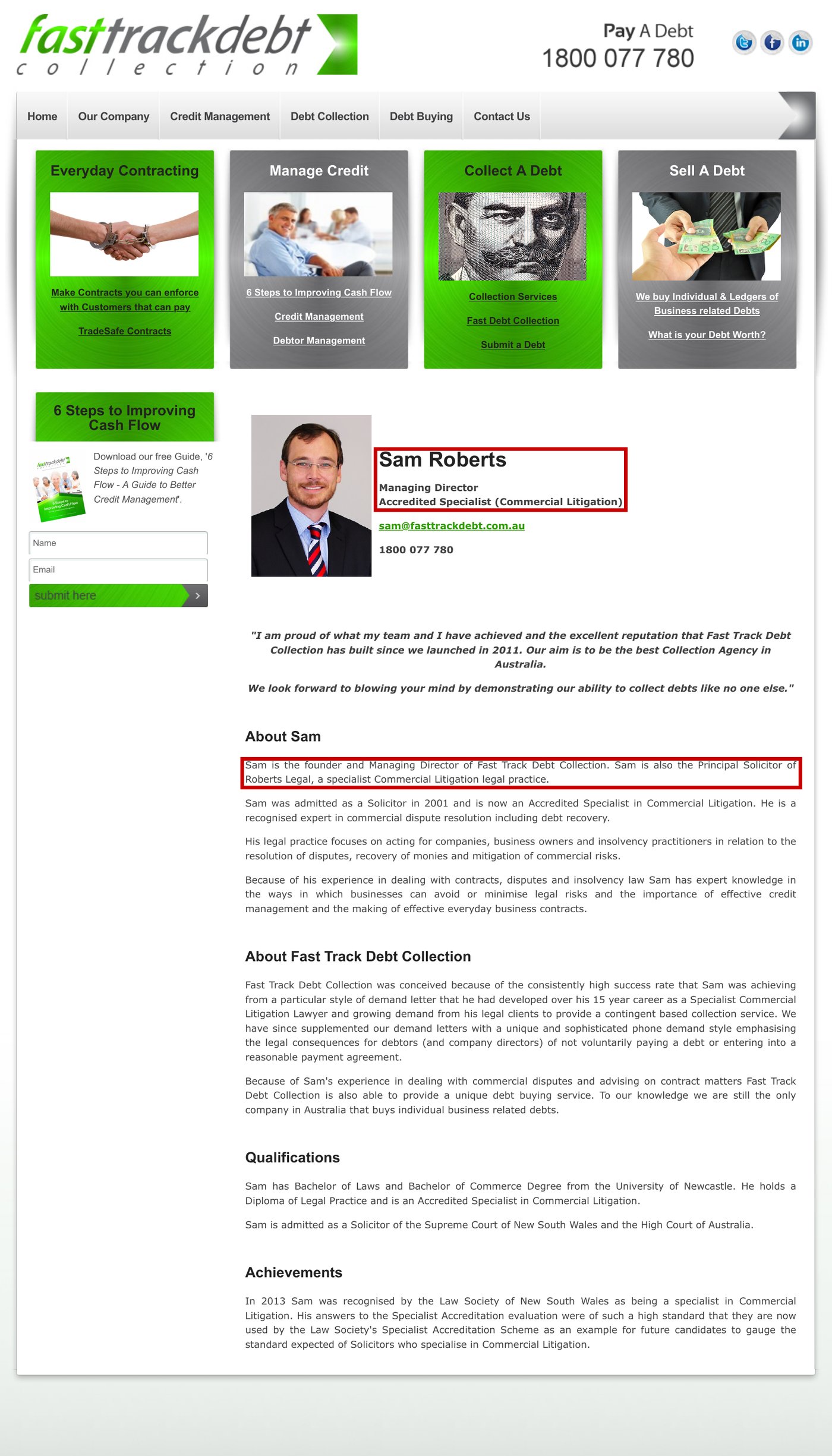
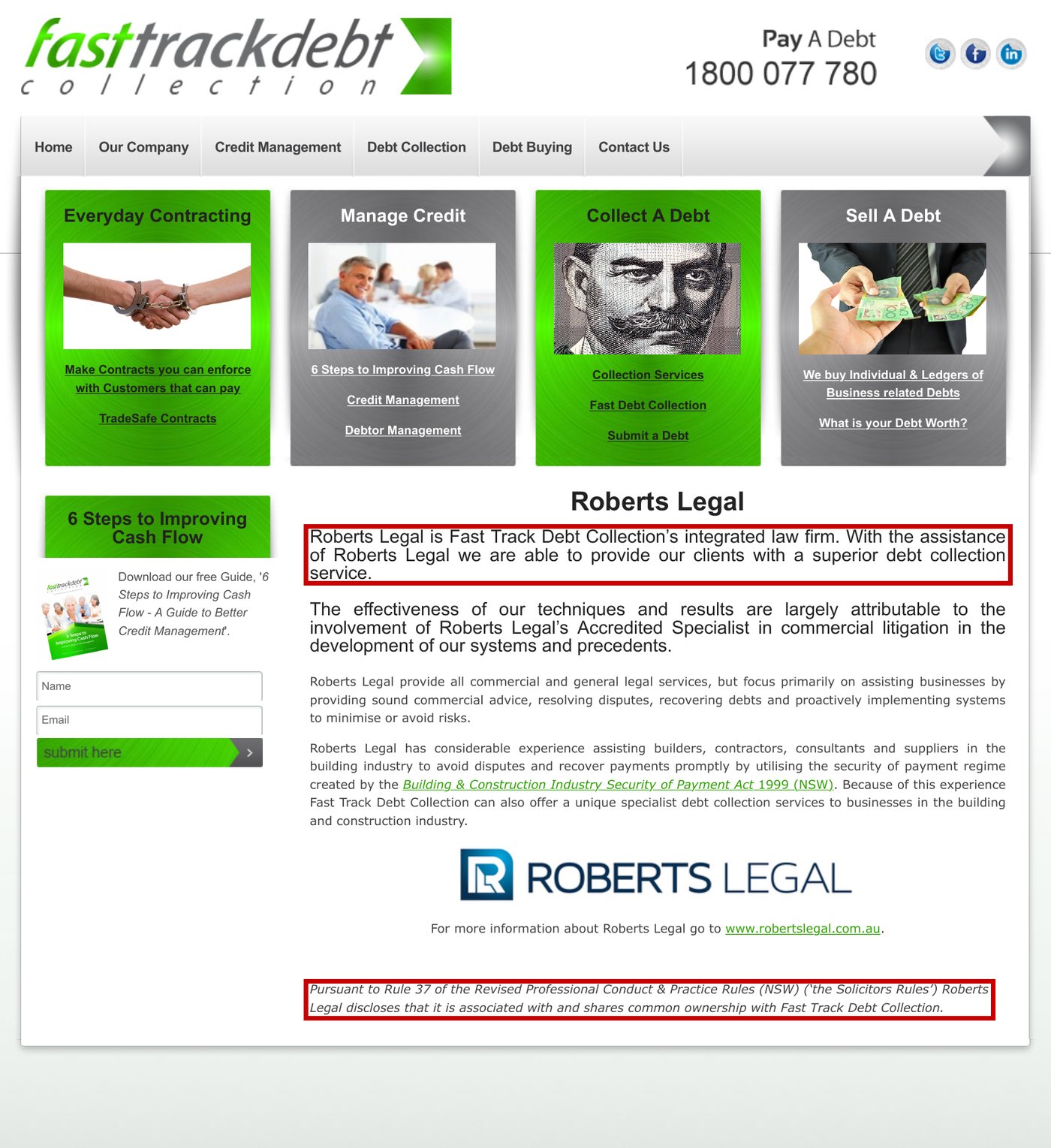
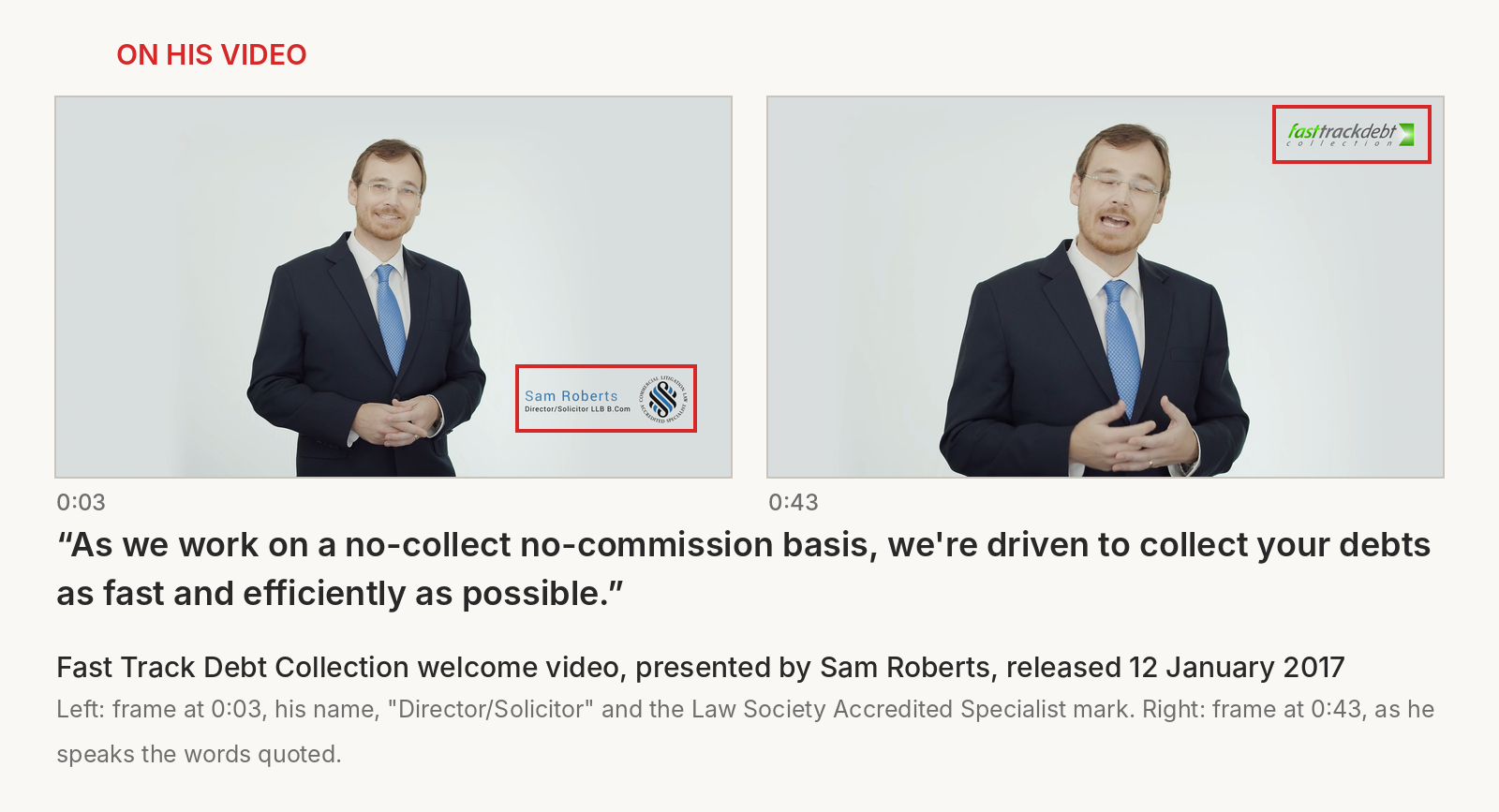
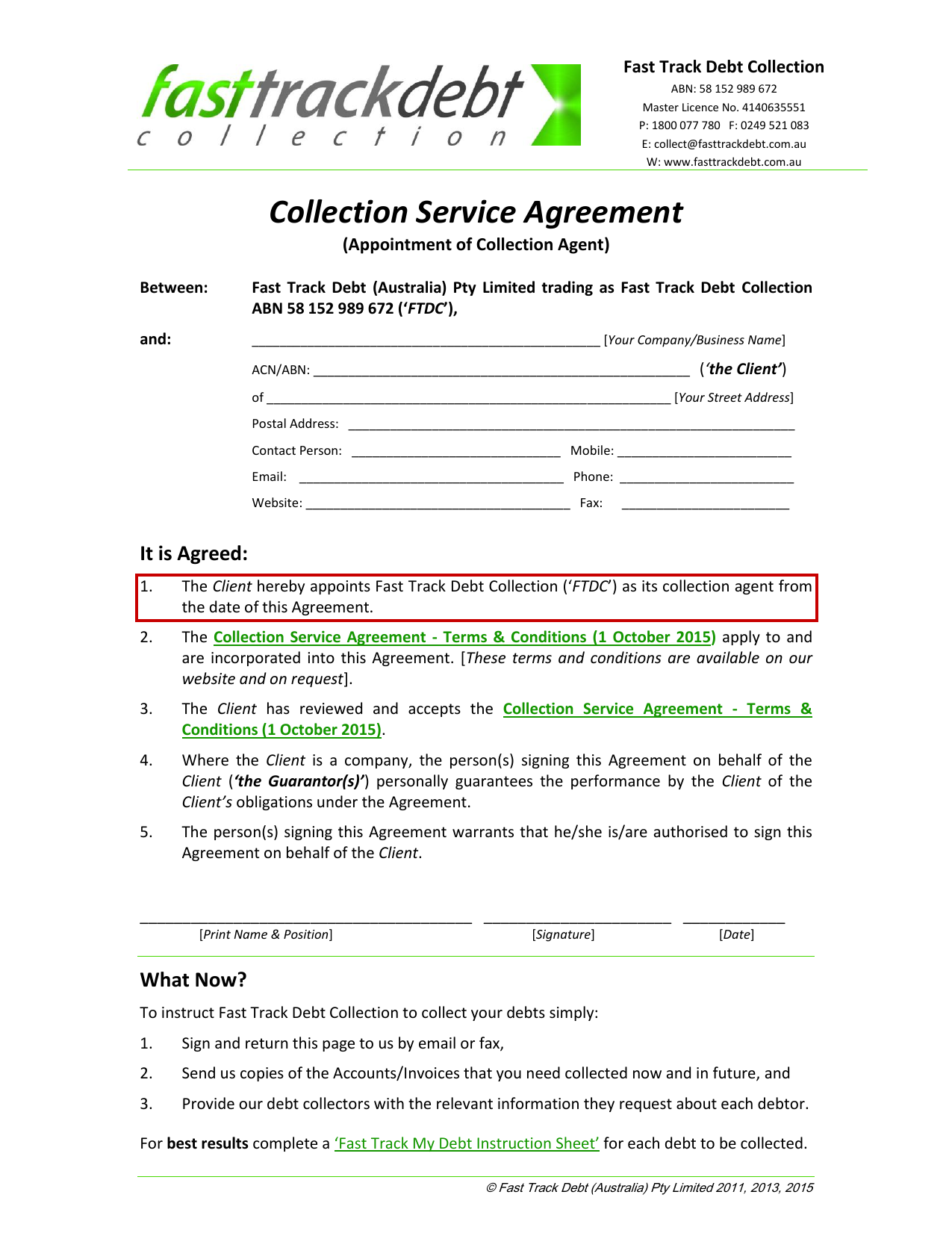
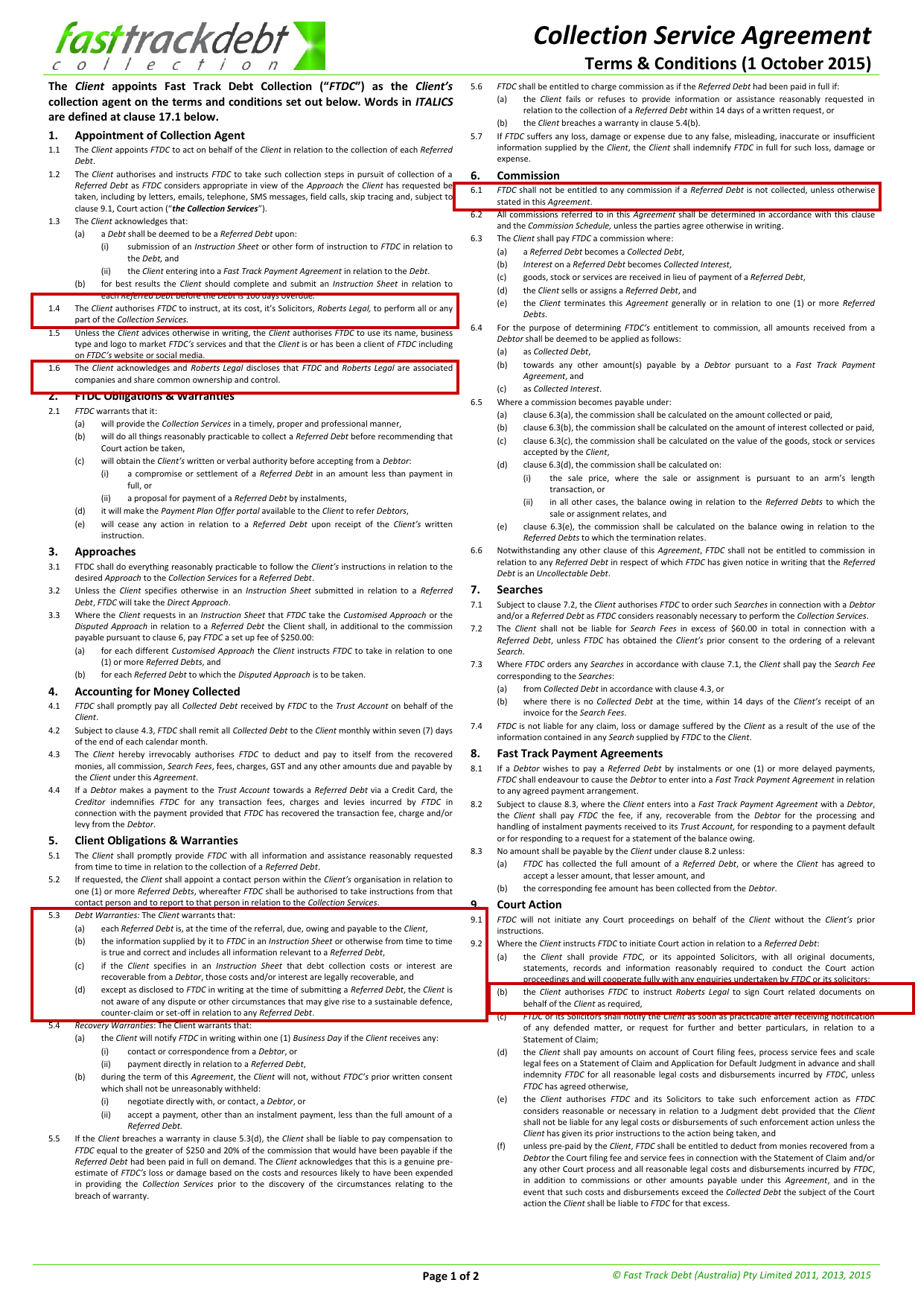
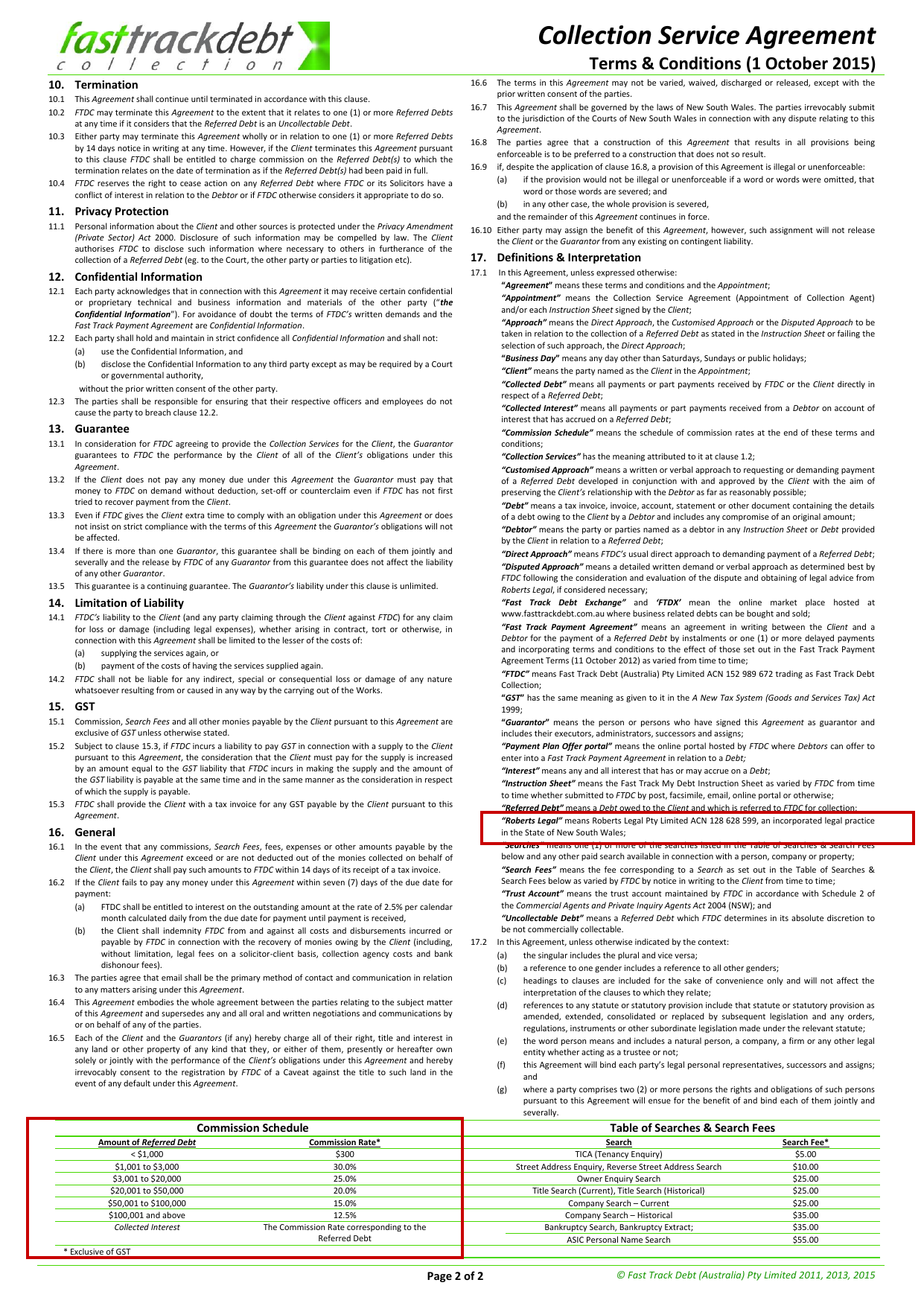
Fast Track website: Sam Roberts’ profile and the Roberts Legal page. Collection Service Agreement, 1 October 2015: appointment form and terms. Fast Track welcome video, 12 January 2017.
3. What he told the OLSC
Mr Roberts told the court he acted for the plaintiff. He told the OLSC that he had “no dealings directly with” the plaintiff “at any time”. He also said his firm acted “at the request of” Fast Track Debt Collection, his own company, which he also calls FTRG.
His letters set out how the practice ran. Each answer is an admission.
| What he told the OLSC | The rule | His letter |
|---|---|---|
| He had “no dealings directly with” the plaintiff “at any time”. His firm acted “at the request of” Fast Track, his own company. | A solicitor acts on the client’s own instructions (Solicitors’ Conduct Rules r 8.1). | 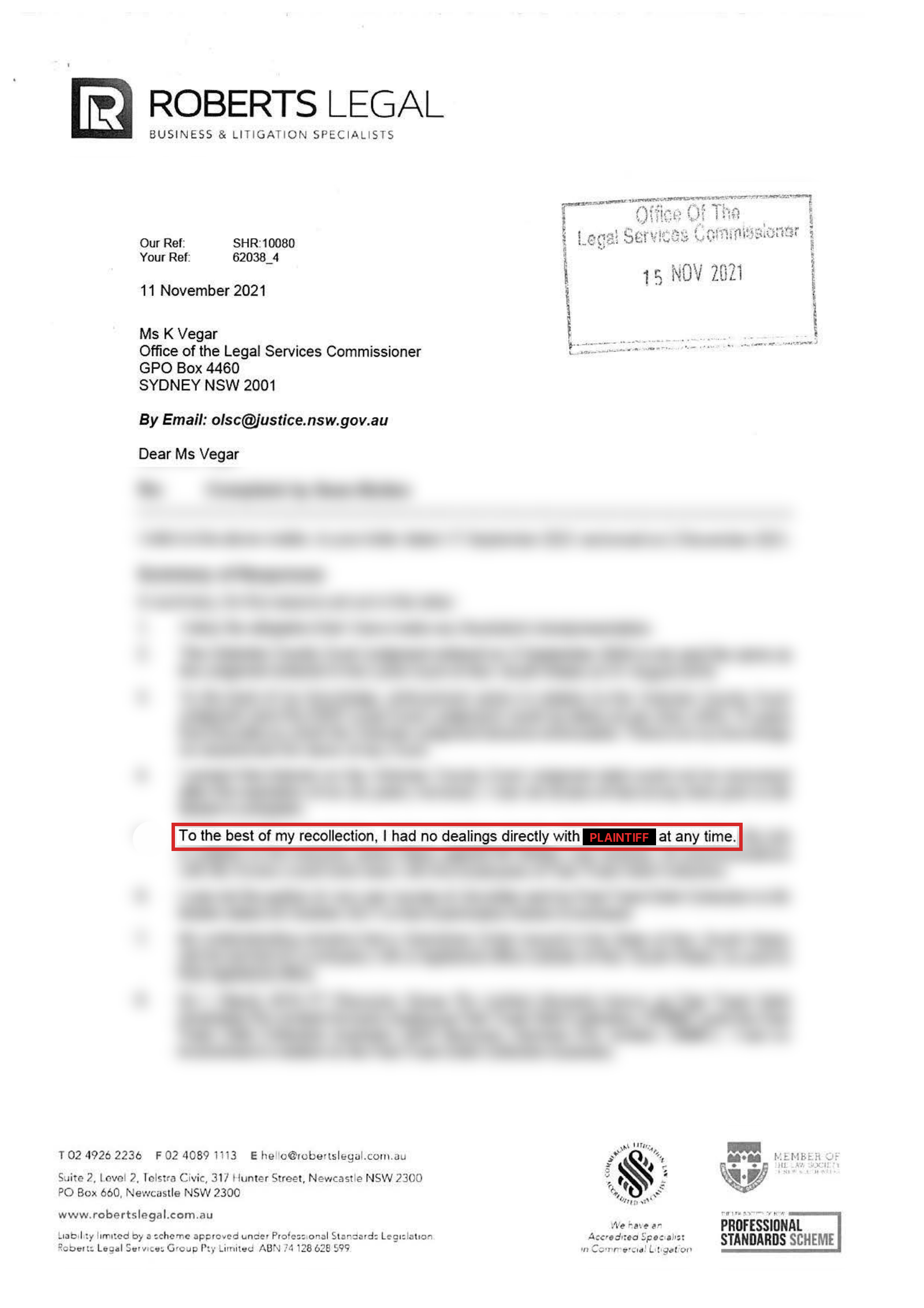 |
| His firm gave the plaintiff no costs disclosure and had no costs agreement with her. | A law practice must disclose how it will charge when it’s first instructed (Uniform Law s 174). | 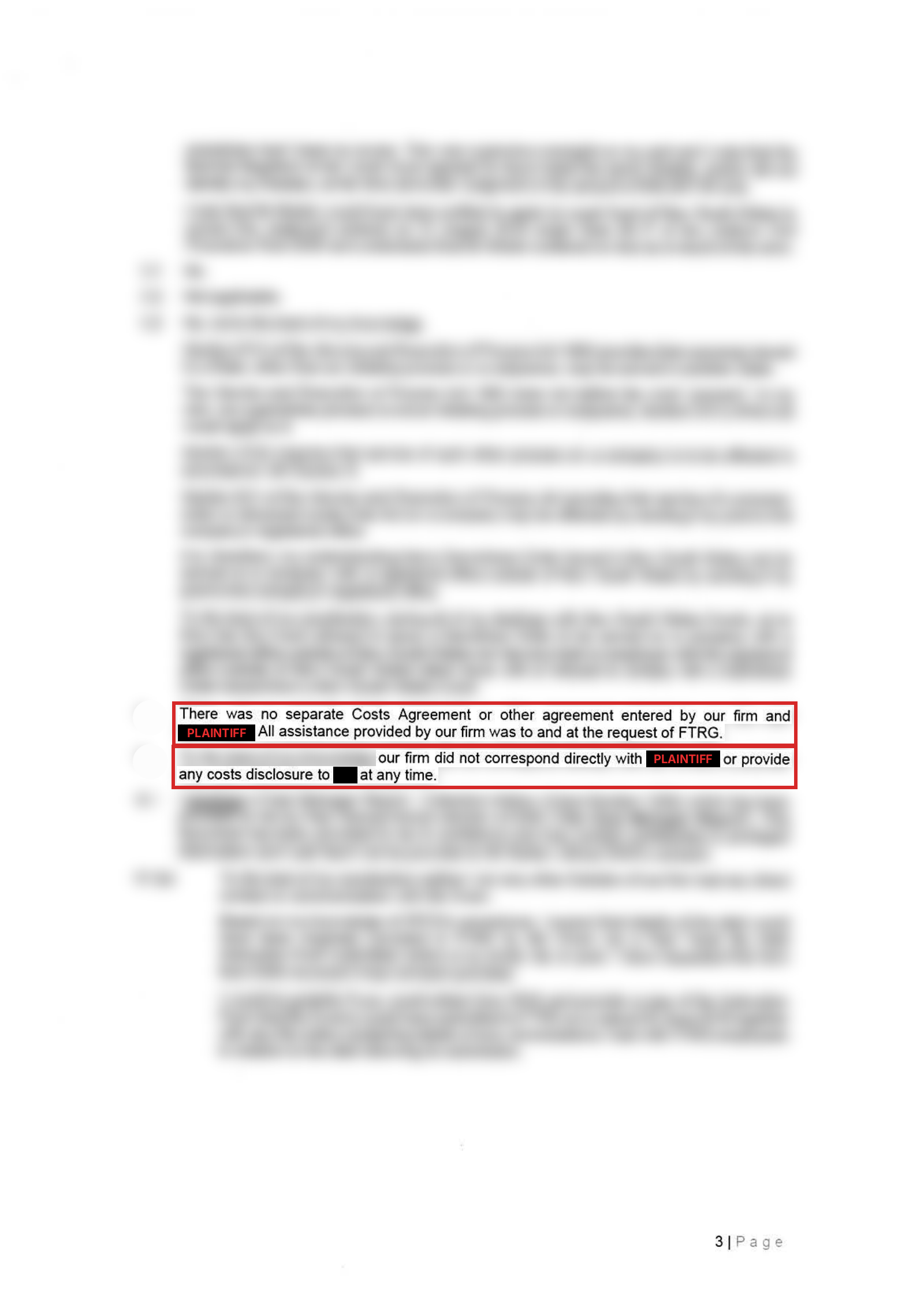 |
| The only agreement was his company’s Collection Service Agreement, which paid a commission on whatever was collected. | A law practice can’t charge by reference to the amount recovered (Uniform Law s 183). | Section 2 |
| He relied on the client’s “warranties” that the debt was “due, owing and payable”. | A solicitor must not mislead the court, knowingly or recklessly (Solicitors’ Conduct Rules r 19.1). | Section 2 |
| His collection staff were “authorised to file legal process via eservices as my delegate”. They signed the garnishee applications as “Commercial Agent” and swore the affidavits. | A lawyer who lets someone else file in their name is taken to have affirmed to the court that they know what it says (UCPR r 3.8(3)). Only a qualified entity can engage in legal practice (Uniform Law s 10). A principal must take reasonable steps to make sure the practice complies (Uniform Law s 34). | 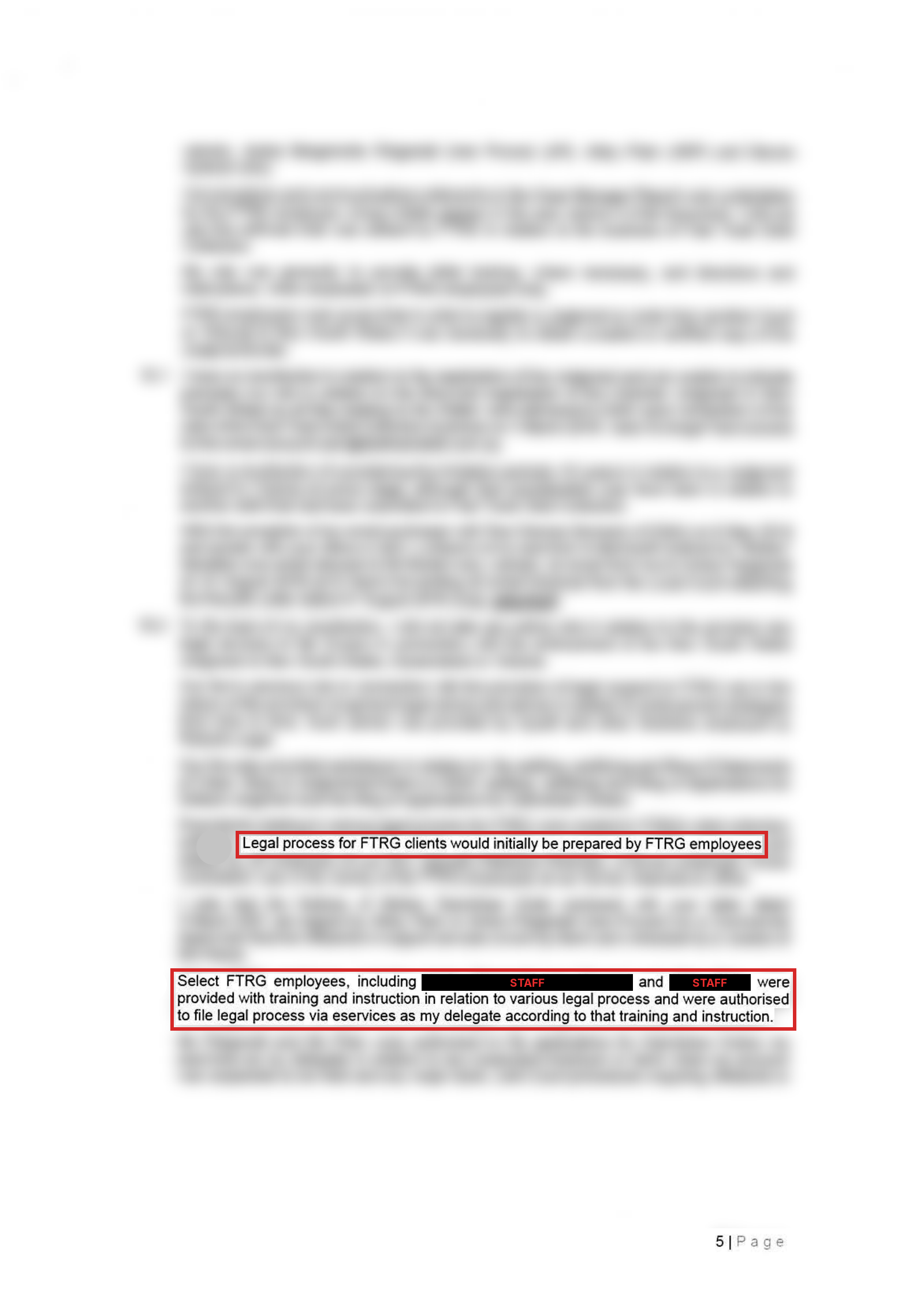 |
| He had “no other documents or files”. | The solicitor on the record must keep control of the matter (Solicitors’ Conduct Rules r 37.1). | 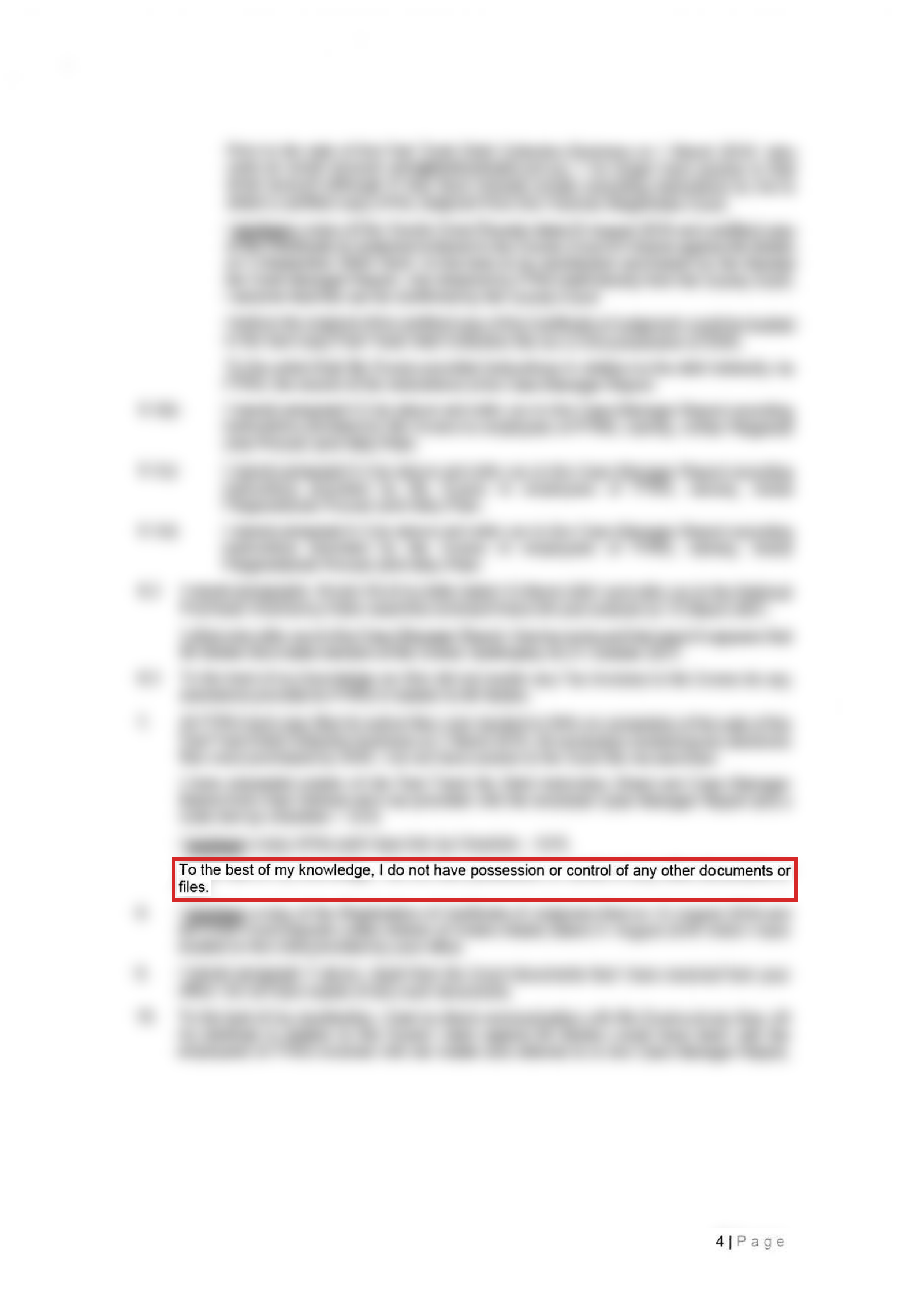 |
| He’d had “no involvement” in the Fast Track business. ASIC records, Fast Track’s website, his LinkedIn and the 2017 welcome video all show he was its director, and so does the OLSC’s own decision. | A solicitor must be open and frank with the regulator (Solicitors’ Conduct Rules r 43.1). |  |
Relying on the client’s word isn’t good enough for a debt collector. In 2020 the Federal Court ordered Panthera Finance to pay $500,000 in penalties for chasing people over debts they didn’t owe, after they’d told it so (ACCC v Panthera Finance Pty Ltd [2020] FCA 340). It isn’t good enough for a solicitor either, because he signs the court documents.
4. The second solicitor
To issue a bankruptcy notice, a creditor needs a judgment less than six years old (Bankruptcy Act 1966 (Cth) s 41(3)(c)). There was no NSW judgment on this file. The only document on it was the registration of a 15-year-old Victorian judgment, on the Certificates list.
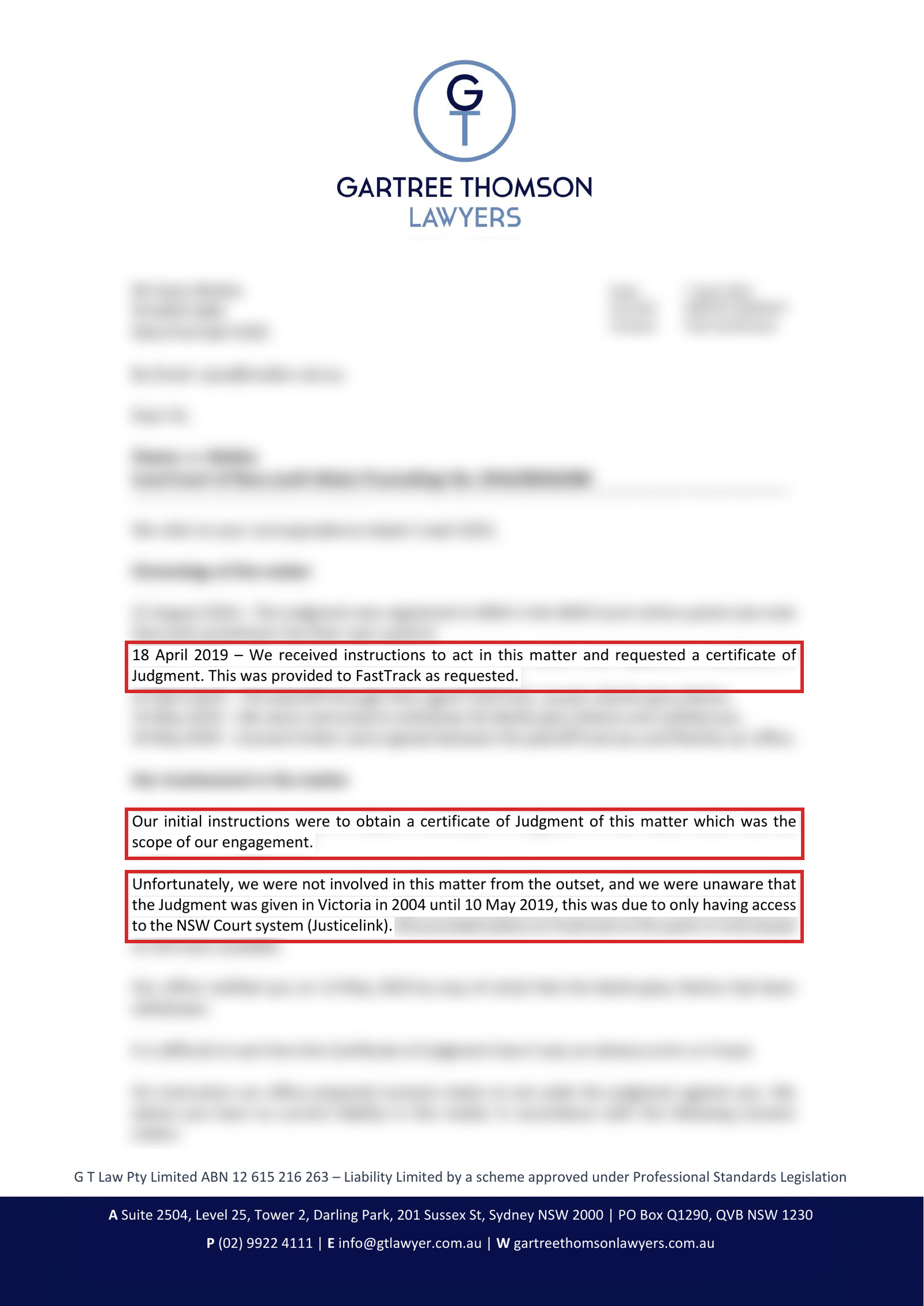
On 18 April 2019 Gartree Thomson Lawyers, Sydney, filed a Notice of Change of Solicitor naming Paul Hutchinson as the plaintiff’s solicitor and saying the plaintiff had appointed him. His firm later said his instructions came from SWA Recovery Services, a debt collector, not the plaintiff.
Two minutes later the same account bought a certificate of judgment (a Form 43) online. His firm says that was the whole job. The certificate showed a judgment date of 31 August 2016, the day of registration, inside the six-year limit. Five days later SWA used it to issue a bankruptcy notice against the defendant in Queensland for $111,379.40.
Mr Hutchinson was the solicitor on the record, and that comes with duties a debt collector doesn’t have. He had to act on the client’s own instructions, not a collector’s (Solicitors’ Conduct Rules r 8.1). He had to supervise everyone working on the matter (r 37.1). Whoever did the clicking, the work was his responsibility. And it was his job to read the file before anyone relied on it. It held one document.
Solicitors must not mislead a court “knowingly or recklessly” (r 19.1). Recklessness doesn’t need an intent to deceive. Going ahead without caring whether something is true is enough.
Mr Hutchinson told the court the plaintiff had appointed him. He says his instructions came from a debt collector. In two minutes he put a stranger in another state at risk of bankruptcy over a false $111,379.40 debt.
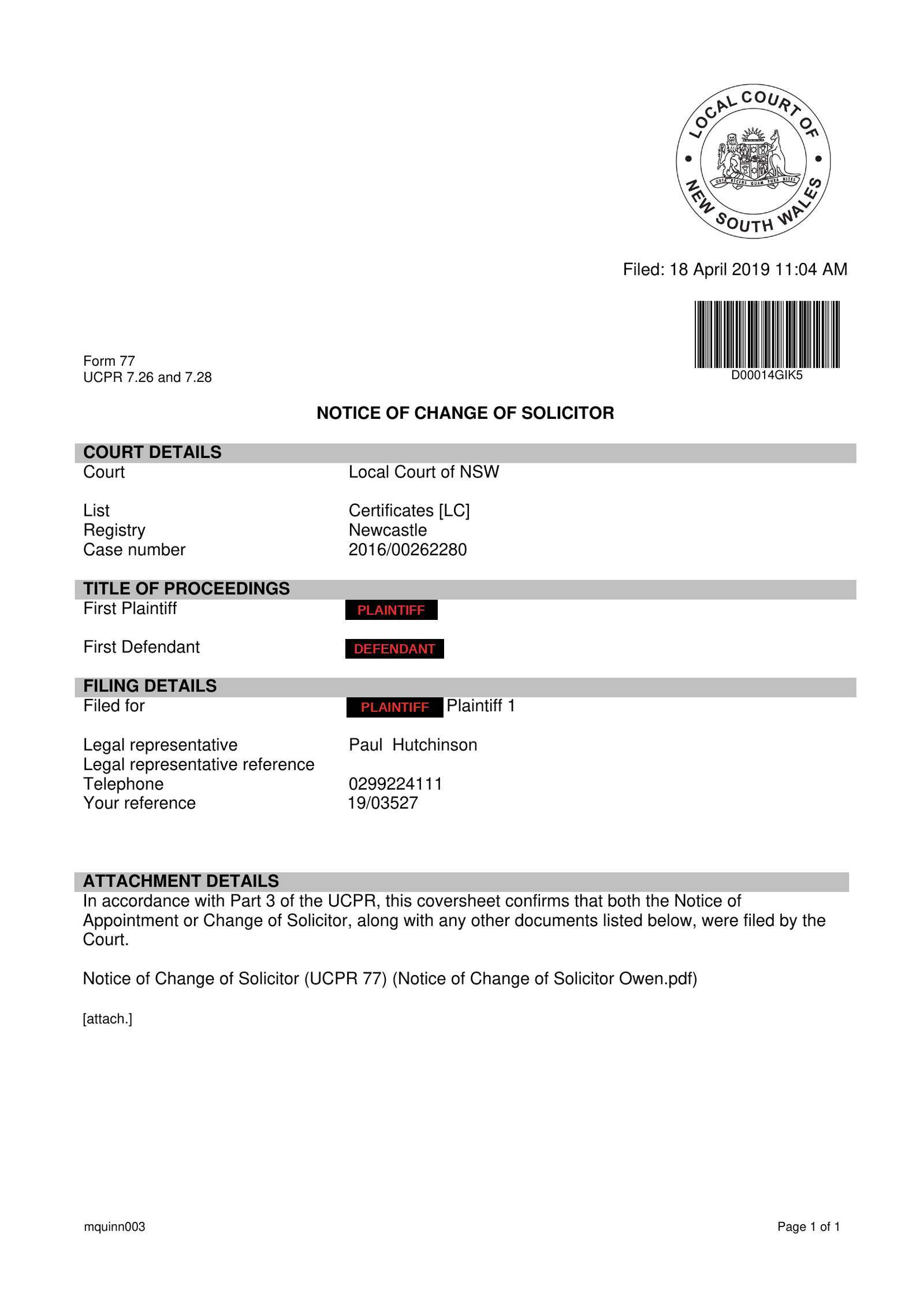
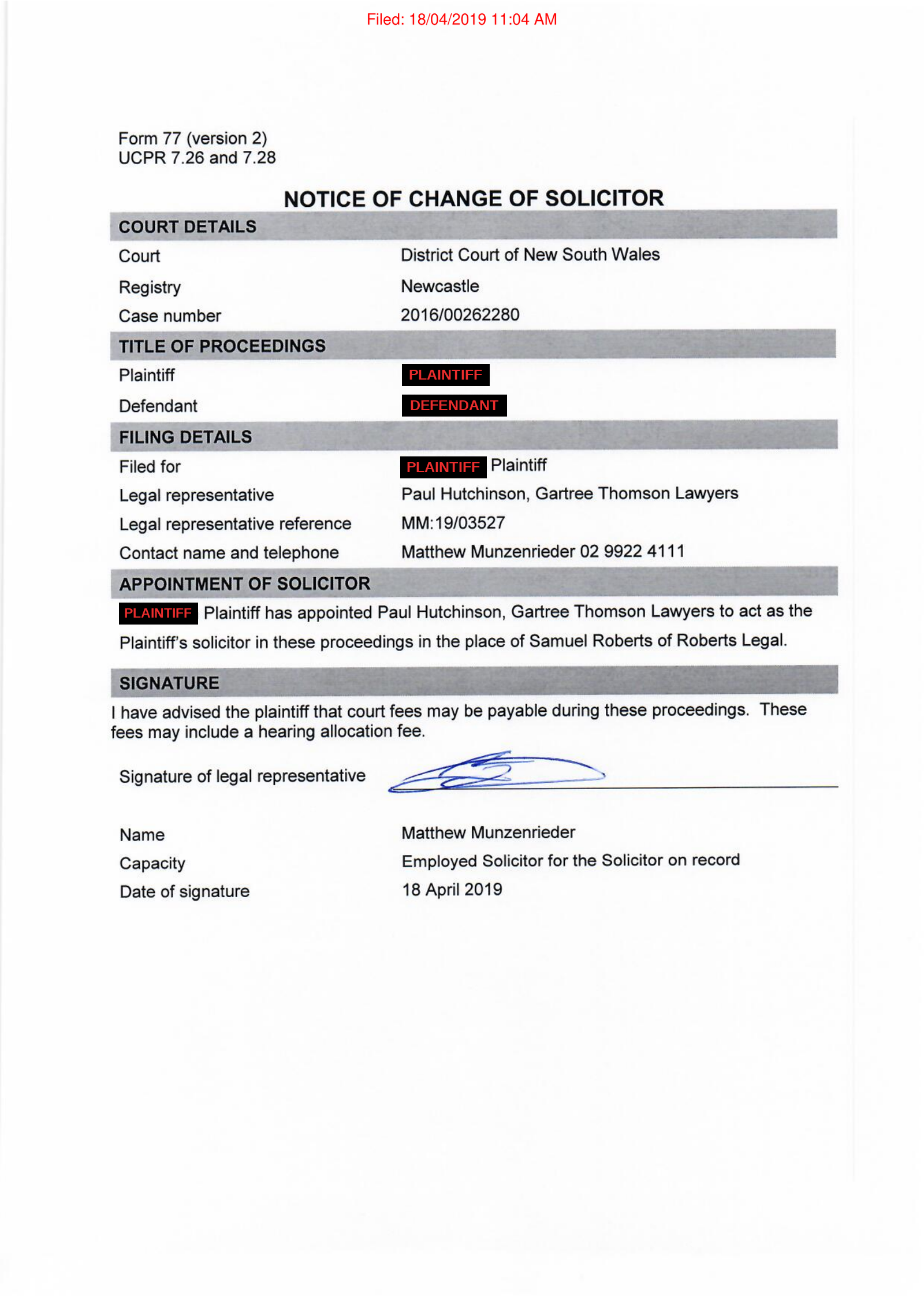
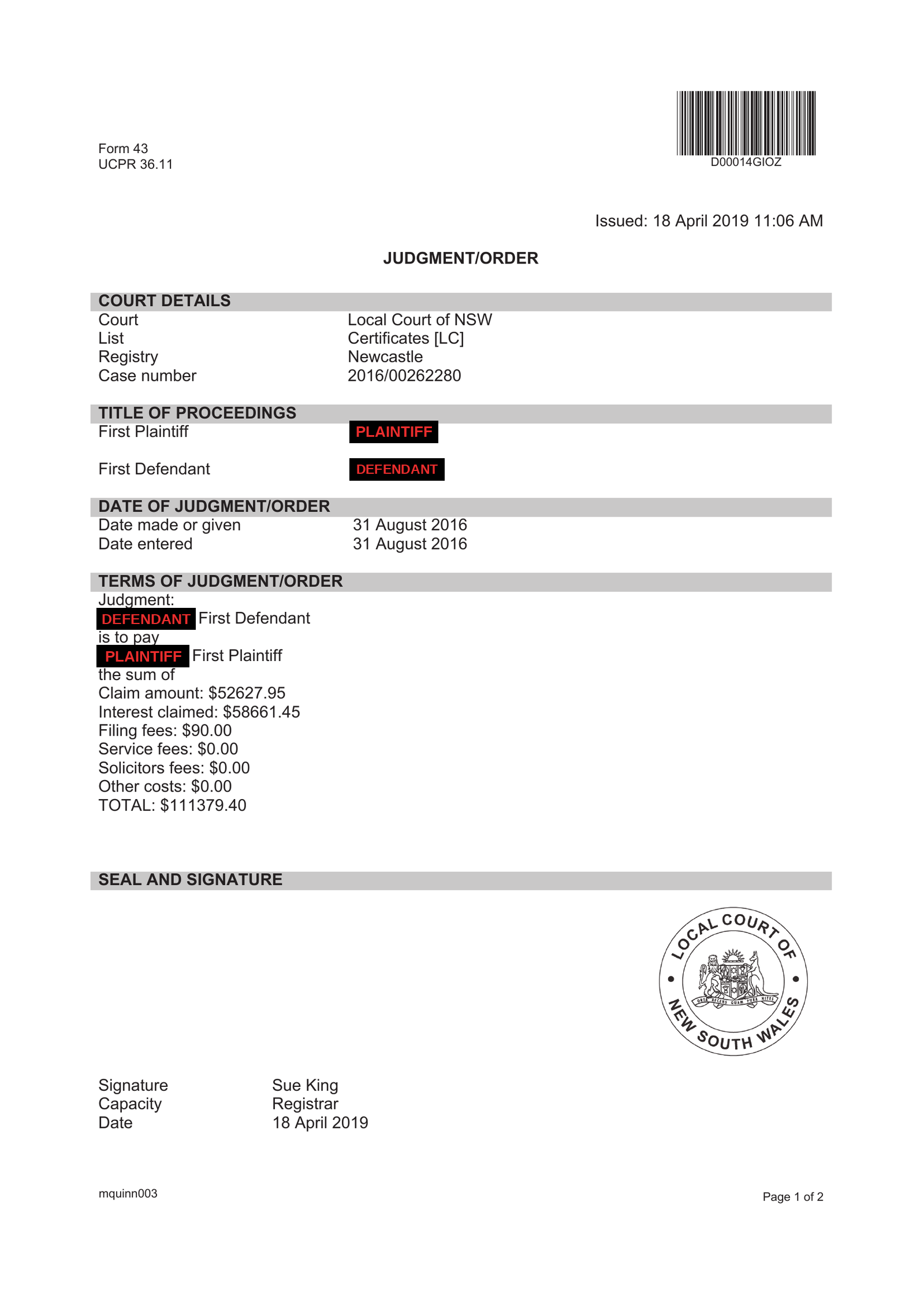
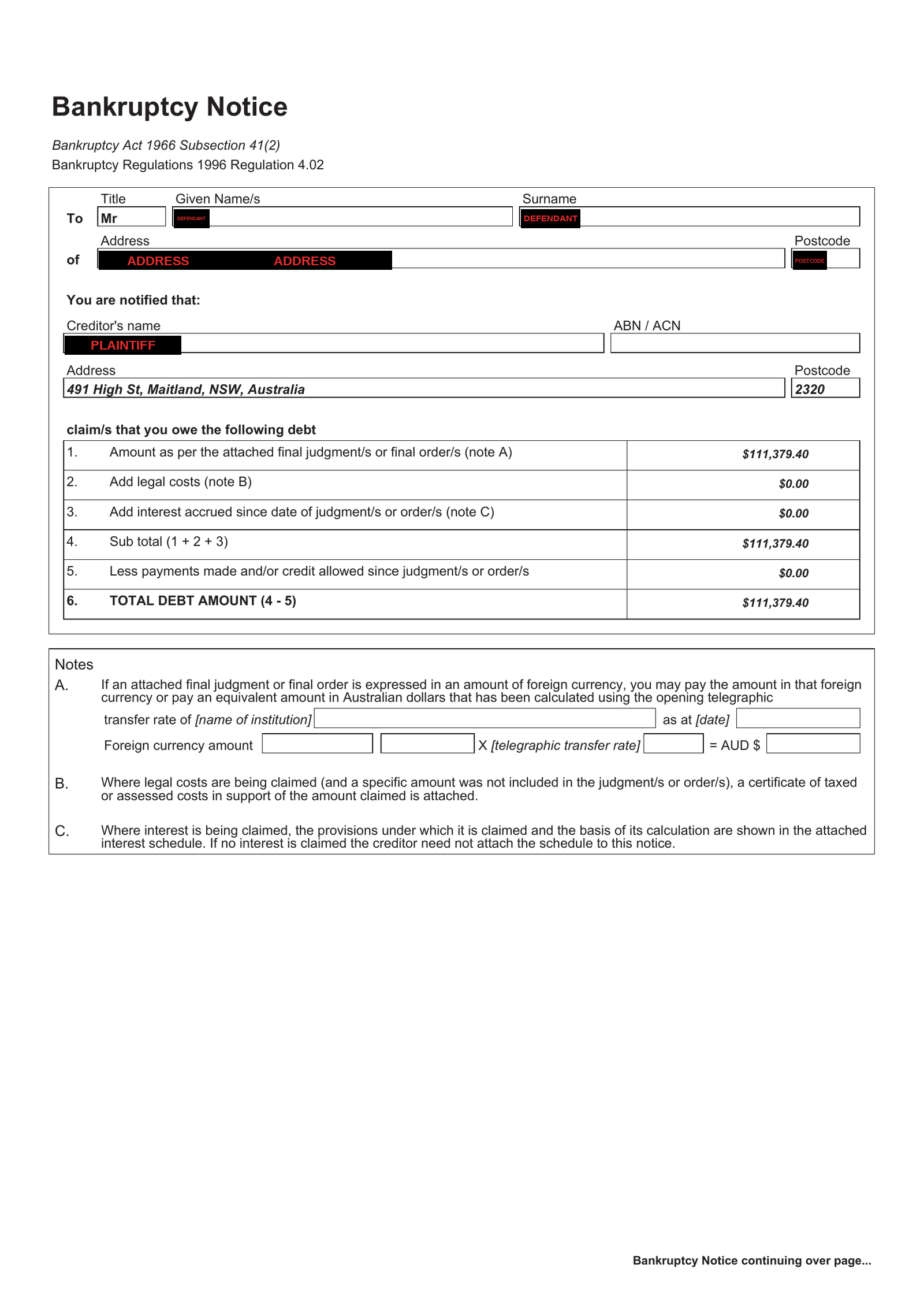
Notice of Change of Solicitor and Form 43, 18 April 2019. Bankruptcy notice, 23 April 2019.
5. The complaint
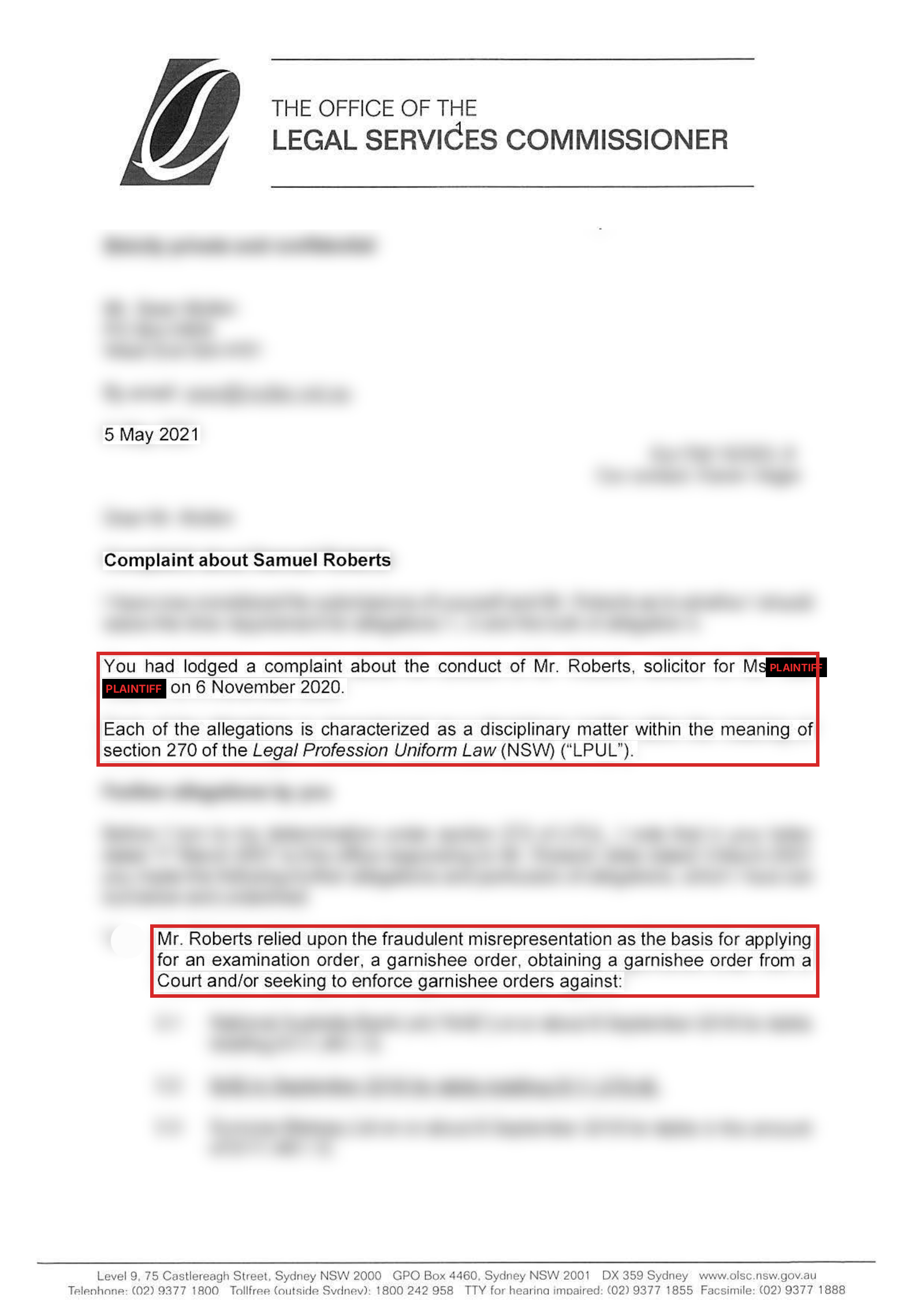
The defendant complained to the OLSC about Mr Roberts on 6 November 2020, and the Queensland Legal Services Commission referred the complaint about Mr Hutchinson on 18 May 2022. The complaint about Mr Roberts said he had misrepresented a registered judgment as a 2016 judgment of the Local Court of NSW, and used it to obtain garnishee orders for more than $100,000.
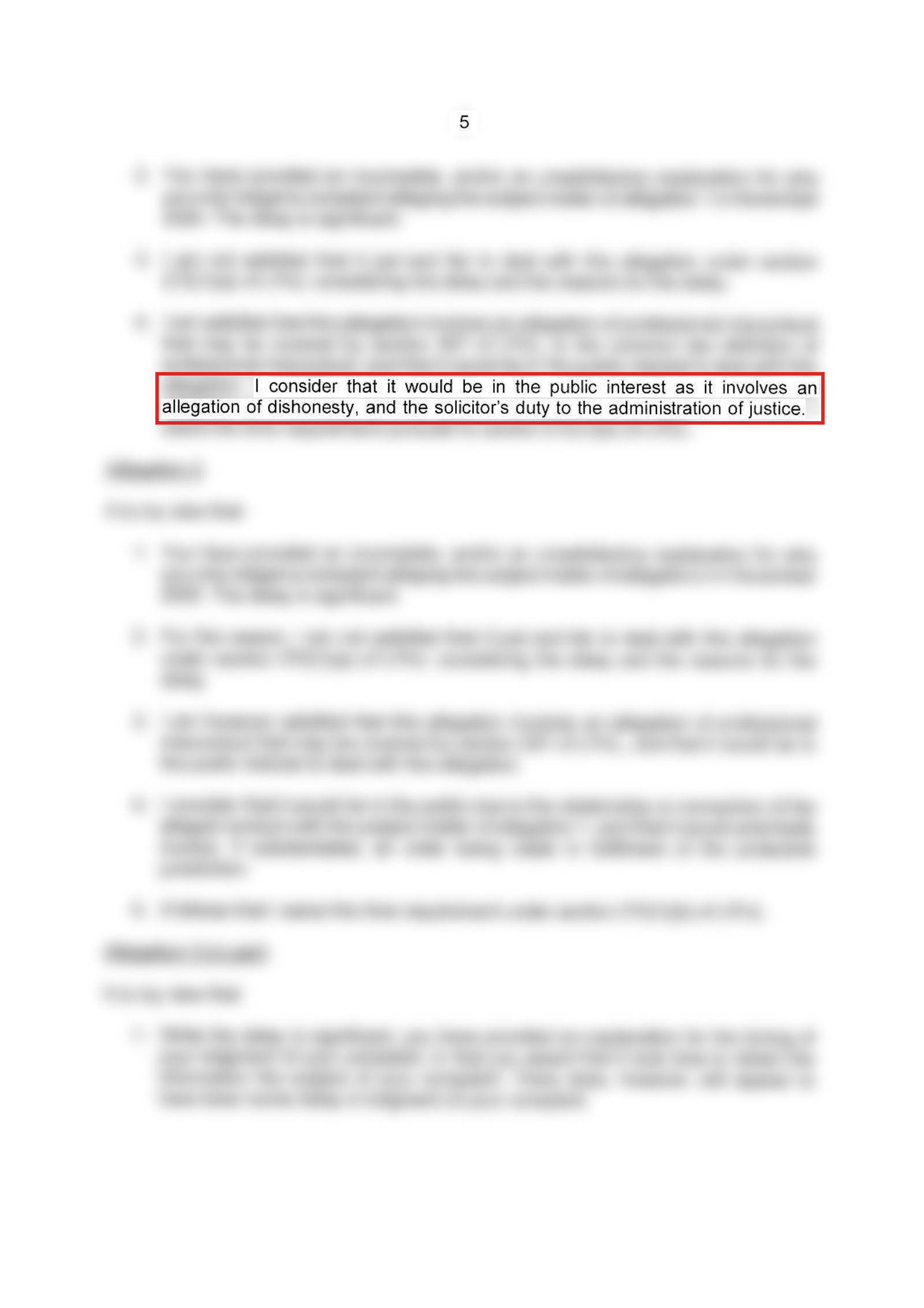
The OLSC understood the complaint. Commissioner John McKenzie set out the allegation in his own words, and classed every part of it as a disciplinary matter, not a consumer dispute. He said it was in the public interest to deal with it, because it alleged dishonesty and went to the solicitor’s duty to the administration of justice.
6. What the OLSC asked, and who it asked
Mr Roberts wrote to the OLSC in March and November 2021 and answered its questions in his own words (section 3).
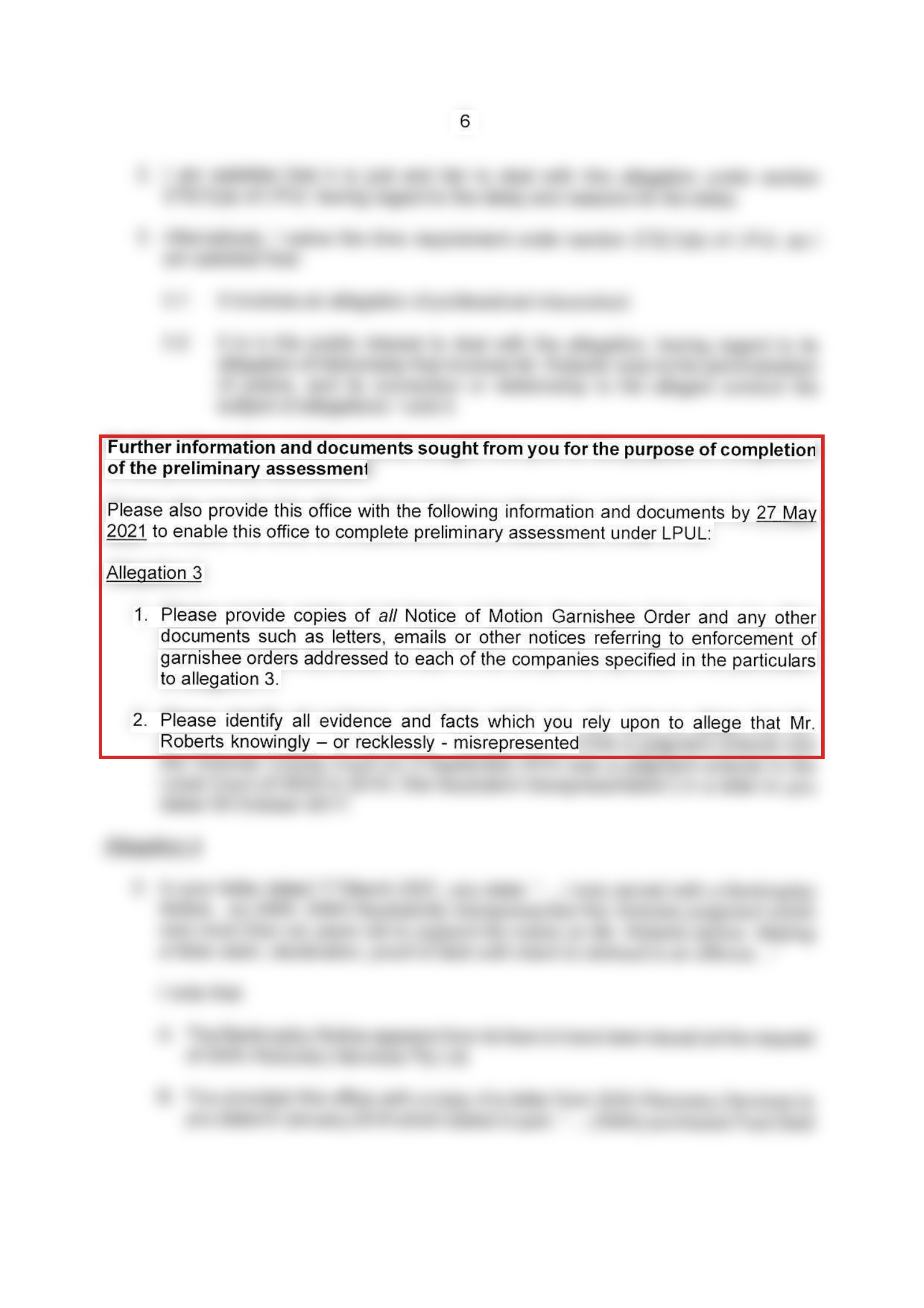
The hard questions went to the complainant. The OLSC asked him for copies of the garnishee applications and orders, which Mr Roberts had filed himself, on a court file Mr Roberts was responsible for. It asked him to “identify all evidence and facts” showing Mr Roberts had acted “knowingly – or recklessly”. That’s a question about what was in the lawyer’s head, put to the one person who wasn’t there.
It didn’t need to know what he was thinking. A solicitor on the record ought to know what he’s filed, and the court file showed what that was. The OLSC is run by lawyers. It ought to have known that too.
It made no sense. Everything that matters in this complaint sits with Mr Roberts: who instructed him, what he knew about the judgment, and the file he had to keep. The OLSC can require a lawyer to produce documents and answer questions (Uniform Law s 371). It didn’t.
7. What the OLSC decided
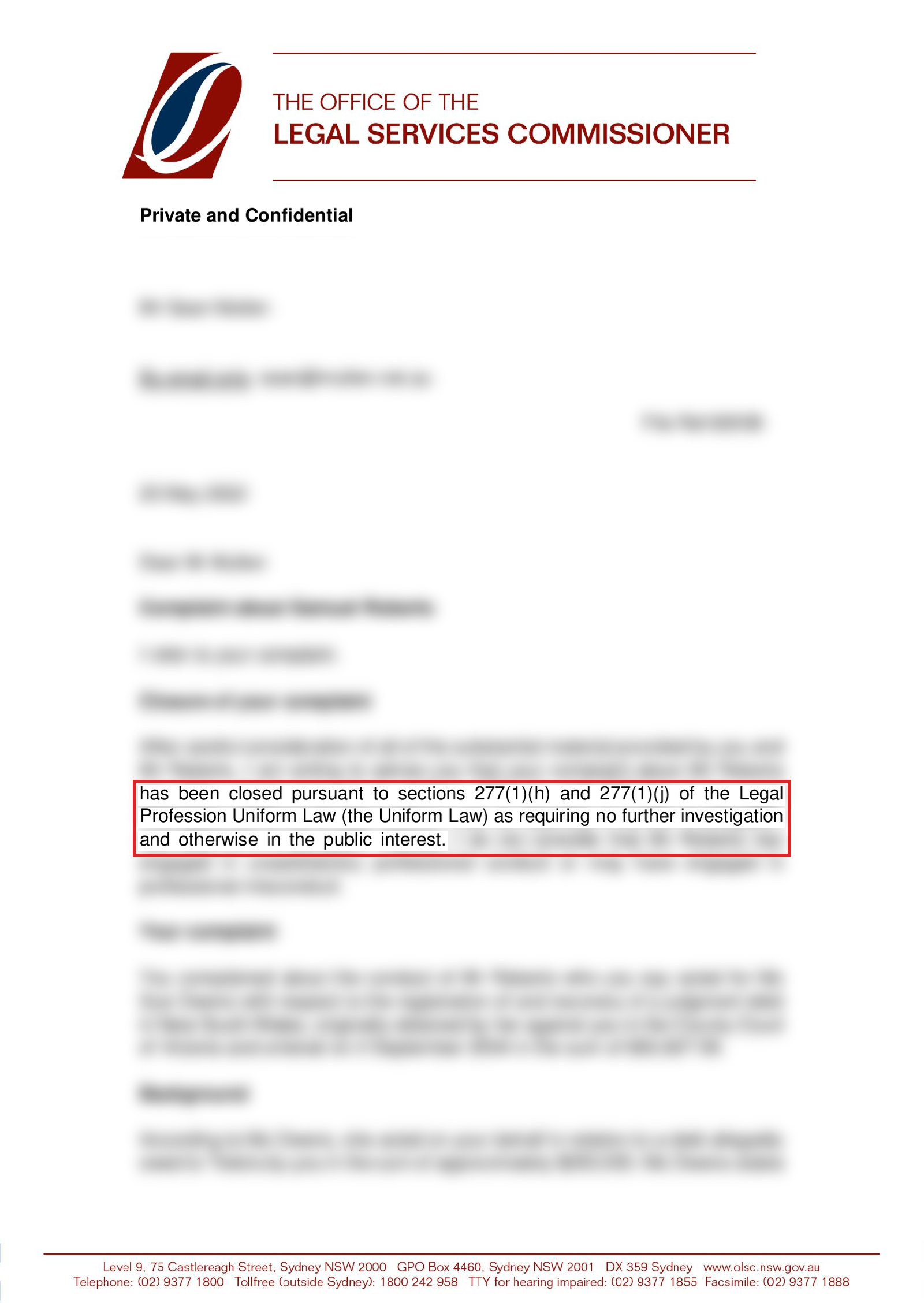
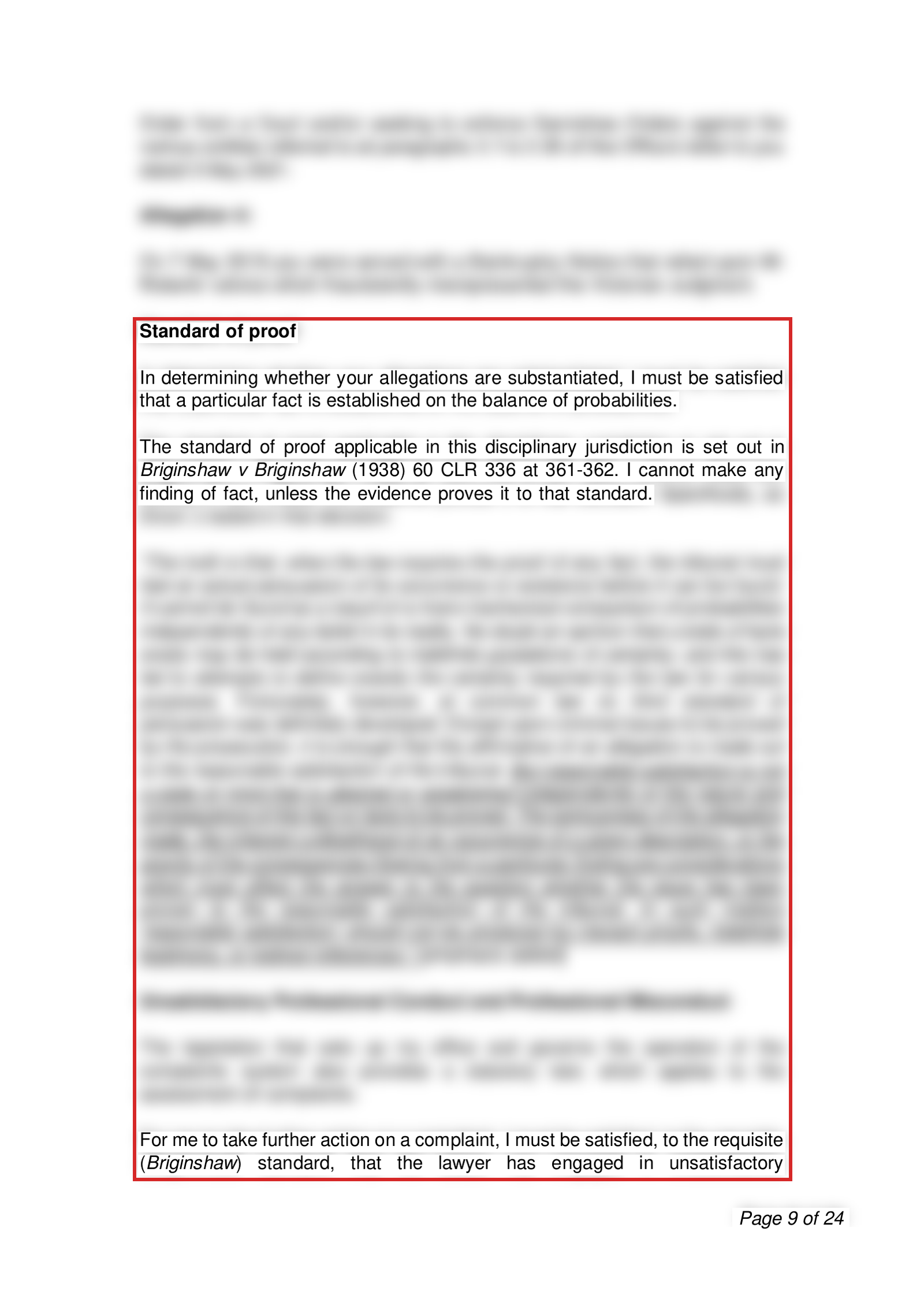
The OLSC closed the Roberts complaint 565 days after it was lodged, as “requiring no further investigation and otherwise in the public interest”. The decision cited Briginshaw, the standard a court applies to evidence after a hearing, eight times, and found the complainant hadn’t met it.
Proving the case was never the complainant’s job. The OLSC is the investigator, and it has the powers to match (section 6). And the case had already been made, by Mr Roberts.
The review
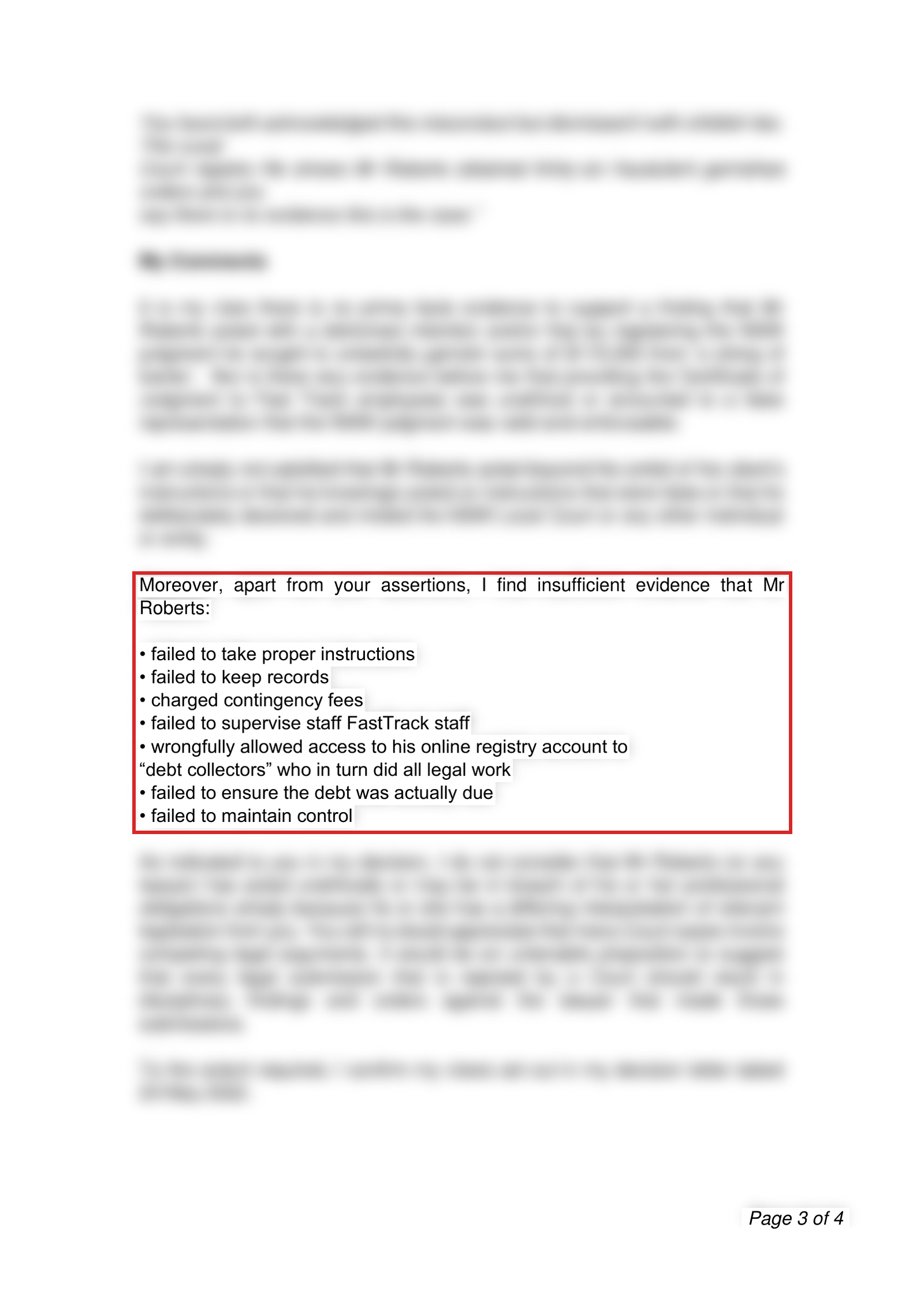
The complainant asked for a review. The OLSC refused it three weeks later. Its letter listed what a solicitor in Mr Roberts’ position had to do, and found “insufficient evidence”, “apart from your assertions”, that he’d failed to do any of it.
The evidence wasn’t the complainant’s assertions. It was Mr Roberts’ own letters to the OLSC, and a court file he alone was responsible for. Every obligation on the OLSC’s list is covered by one of his admissions (section 3).
The OLSC had these admissions in writing for more than six months before it found there was no evidence.
Mr Hutchinson
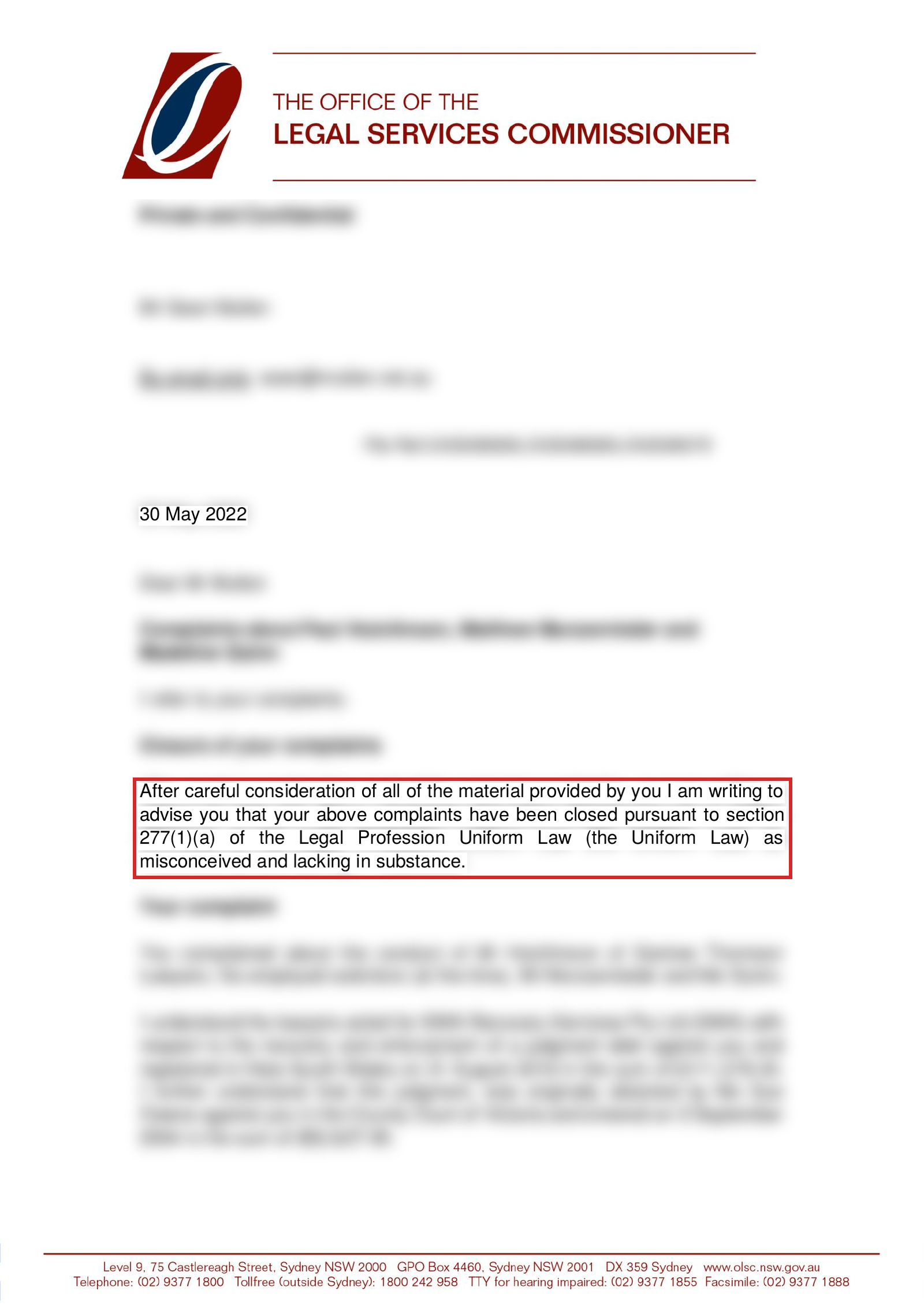
Twelve days after the referral, the OLSC closed the Hutchinson complaint as “misconceived and lacking in substance”. Nothing was asked of him.
The answer was already on its file. Mr Hutchinson told the court the plaintiff had appointed him (section 4). His firm’s letter says his instructions came from SWA, and the OLSC’s decision records that his firm acted for SWA.
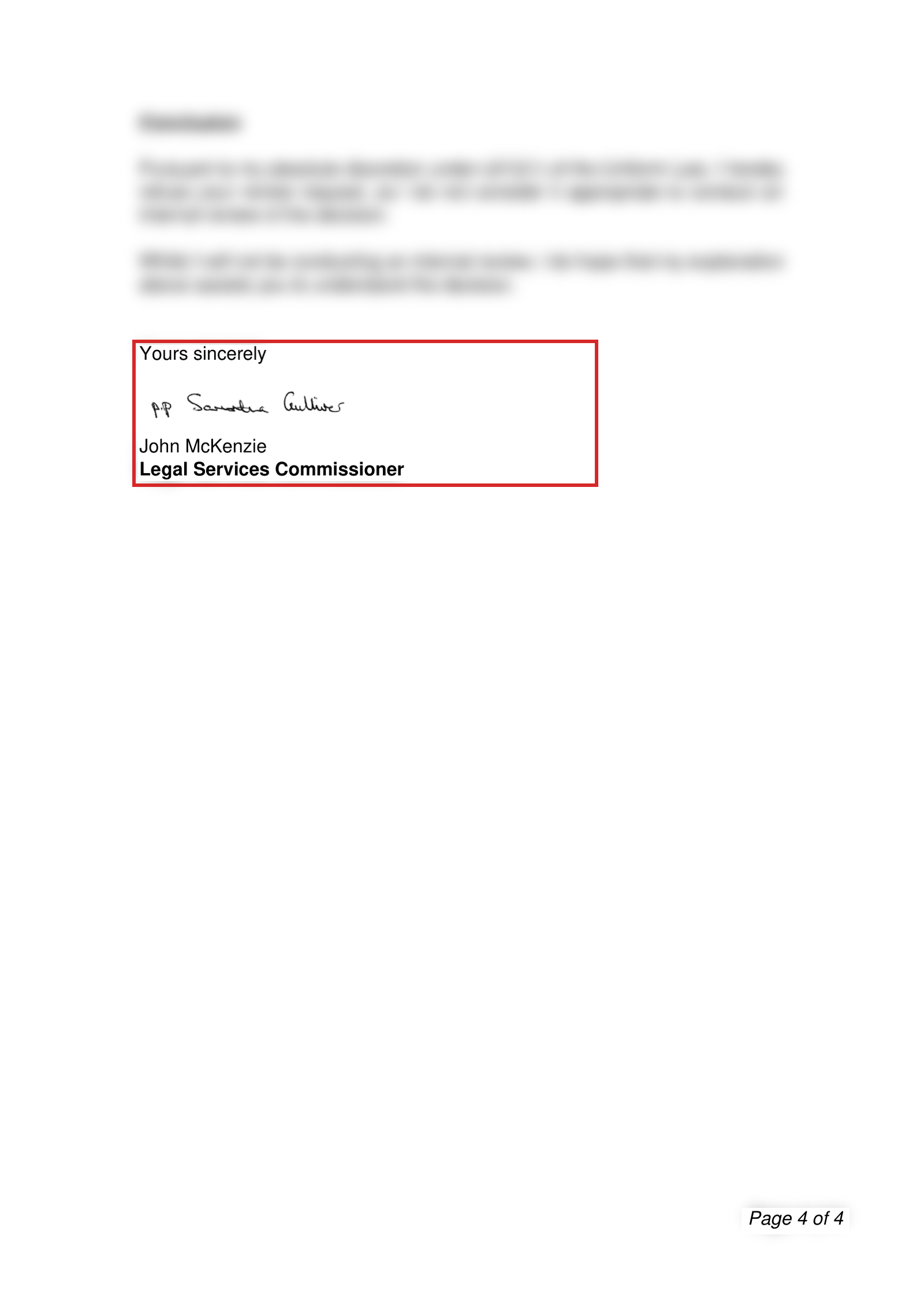
Samantha Gulliver, then the OLSC’s Assistant Commissioner (Legal), signed all three decisions for the Commissioner, John McKenzie. She has been the Commissioner since March 2024.
8. What the OLSC’s decisions allow
Put the two decisions together. By the OLSC’s reckoning, a solicitor can go on the record for a client he’s never dealt with. He can take his instructions from his own debt collection company and work under its commission agreement. He can let its staff file in his name, keep no file, and enforce a NSW judgment that didn’t exist on 24 garnishee orders. A second solicitor can put his name on the court file for a debt collector and buy the certificate it used for a bankruptcy notice. He wasn’t asked a single question.
Every one of those breaks a rule set out on this page. The OLSC found none of them worth investigating. In practice, the rules didn’t apply.
Sources
- Registration of certificate of judgment and Notice of Orders Made, Local Court of NSW, 31 August 2016 (exhibits).
- Email, Mr Roberts to staff, 31 August 2016, 5:14 pm (exhibit).
- Garnishee application and order, 5 September 2016; the 24 orders, September 2016 to March 2018 (exhibits).
- Roberts Legal to the OLSC, 12 March and 11 November 2021 (exhibits).
- Fast Track Debt Collection welcome video, presented by Sam Roberts, 12 January 2017 (exhibit).
- Notice of Change of Solicitor and Form 43 Judgment/Order, 18 April 2019; bankruptcy notice, 23 April 2019; Gartree Thomson letter, 7 April 2021 (exhibits).
- OLSC letter, 5 May 2021; OLSC decision (Roberts), 25 May 2022; OLSC review refusal, 16 June 2022; OLSC decision (Hutchinson), 30 May 2022 (exhibits).
- Legal Profession Uniform Law (NSW) ss 10, 34, 174, 183, 371; Legal Profession Uniform Law Australian Solicitors’ Conduct Rules 2015 rr 8.1, 19.1, 37.1, 43.1.
- Uniform Civil Procedure Rules 2005 (NSW) r 3.8(3); Bankruptcy Act 1966 (Cth) s 41(3)(c); Service and Execution of Process Act 1992 (Cth) s 105(5); Supreme Court (General Civil Procedure) Rules 2015 (Vic) r 68.02.
- ACCC v Panthera Finance Pty Ltd [2020] FCA 340.
- Office of the NSW Legal Services Commissioner, Annual Report 2021-22, Commissioner’s report.